Blogs

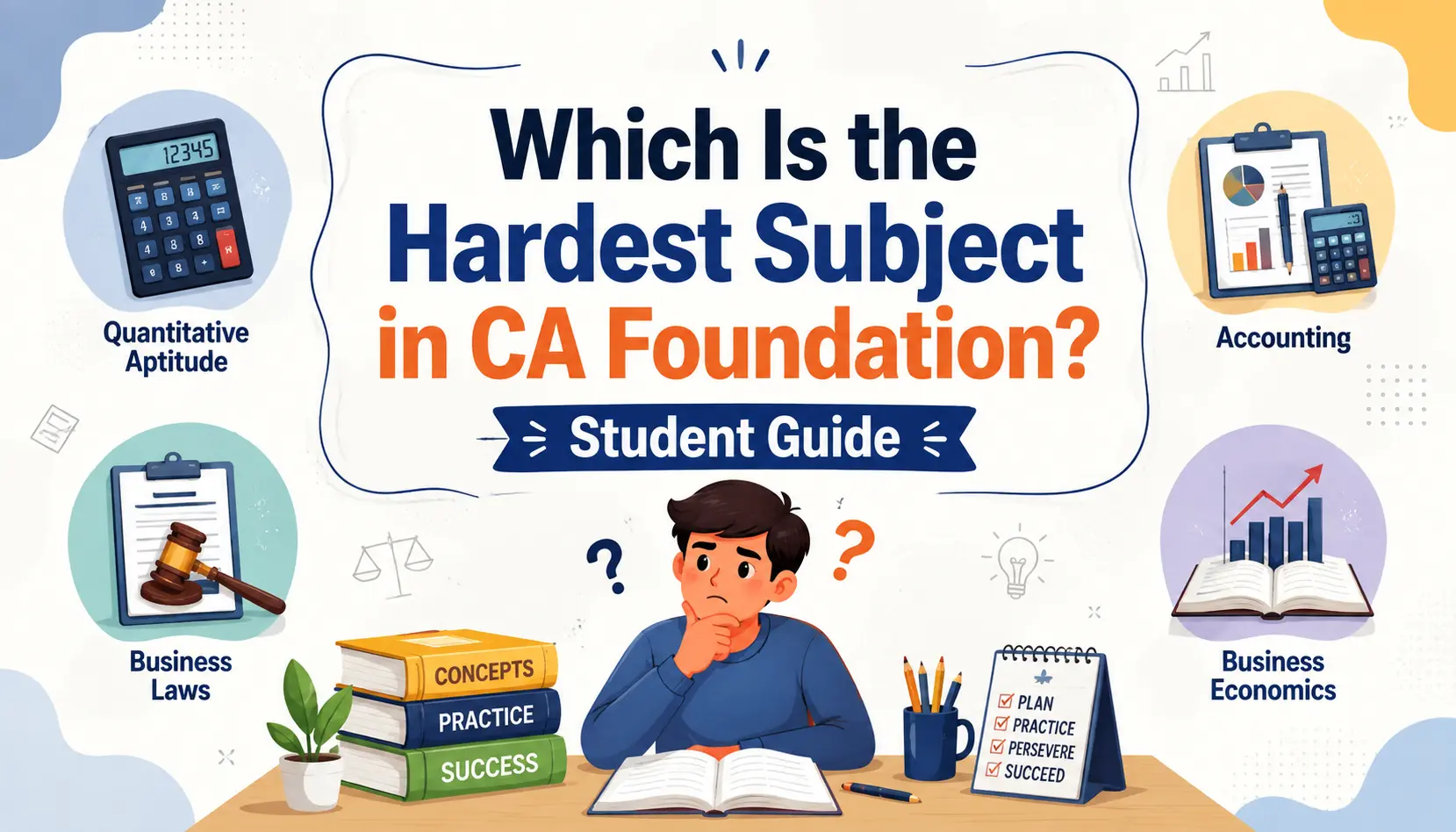
Which Is the Hardest Subject in CA Foundation? Student Guide

One of the most common questions among CA Foundation students is, “Which is the hardest subject in CA Foundation?” Some students find Business Laws difficult, while others struggle with Quantitative Aptitude, Accounting, or Business Economics. But the reality is that there is no single hardest subject for every CA Foundation student. The difficulty of a subject depends on a student’s academic background, previous learning experience, preparation, and individual strengths. Is There Any Hardest Subject in CA Foundation? No, there is no universally hardest subject in CA Foundation. All four subjects have their own advantages and challenges. A subject that feels easy to one student may feel difficult to another. For example, a student with a strong Mathematics background may find Quantitative Aptitude easier, while a student with a Commerce background may feel more comfortable with Accounting. This is why students should focus less on what others consider difficult and more on identifying which subject is personally challenging for them. Which CA Foundation Subject Is Difficult for Science Students? Students coming from a Science background may already have good exposure to mathematical concepts. Because of this, Quantitative Aptitude may feel comparatively easier for them. However, they may need more effort in subjects such as Accounting, Business Laws, and Business Economics, especially if they have not studied these subjects previously. This does not mean that these subjects are difficult for every Science student. It simply means that their previous academic background can affect their initial level of comfort. Which CA Foundation Subject Is Difficult for Commerce Students? Commerce students may already have some familiarity with Accounting, which can make the subject easier for them. However, Quantitative Aptitude may require additional preparation for students who have not continued with Mathematics or have moved away from it during their school years. Therefore, a Commerce background does not automatically make CA Foundation easy. Students still need to identify their weak areas and prepare accordingly. Is Business Laws the Hardest Subject? Many students consider Business Laws difficult because the subject requires both conceptual understanding and proper answer writing. Reading the subject may be interesting, but students can face difficulty when they have to understand a concept and express it correctly in an answer. Since Law can be relatively new for many students, it may take some time to become comfortable with its concepts and writing style. The solution is to focus on understanding the concepts first and then work on writing answers based on that understanding. Is Quantitative Aptitude the Hardest Subject? Quantitative Aptitude can be challenging for students who are not comfortable with Mathematics or have not studied it recently. On the other hand, students with a stronger mathematical background may find QA comparatively easier. Therefore, QA cannot be called the hardest subject for everyone. Its difficulty largely depends on a student’s previous exposure to Mathematics and regular practice. Is Accounting the Hardest Subject? Accounting can feel difficult, particularly for students who do not have a strong Commerce background. Students who have already studied Accounting may find the concepts more familiar, while students from other backgrounds may need additional time to understand them. So, whether Accounting is difficult depends largely on the student’s previous knowledge and preparation. Is Business Economics the Hardest Subject? Business Economics can also be challenging when students lack conceptual clarity. Since the subject follows an MCQ-based pattern, simply memorising information may not always be enough. Students need to understand the concepts properly so they can apply their knowledge while answering questions. Regular revision and conceptual understanding are therefore important for improving performance in Economics. How to Identify Your Difficult CA Foundation Subject? Instead of asking which subject is hardest for everyone, students should identify their own weak subject. Ask yourself: Which subject do I understand the least? Where do I make the most mistakes? Which subject requires the most revision? Which topics take me longer to understand? Which subject makes me feel least confident? The answers will help you understand where you need to put additional effort. How to Improve in a Difficult Subject? Once you identify your weak subject, focus on improving it instead of avoiding it. Build conceptual clarity: Understand the basic concepts before moving to advanced topics. Practise regularly: Consistent practice can make difficult topics more familiar. Give extra time to weak areas: You do not need to spend exactly the same amount of time on every subject. Work on answer writing: This is especially important when preparing for subjects where students need to explain concepts properly. Take appropriate guidance: If you are repeatedly struggling with a subject, guidance from the right professor or coaching option can help you understand the subject in a more structured way. Final Answer There is no single hardest subject in CA Foundation. The difficulty of Accounting, Business Laws, Quantitative Aptitude, or Business Economics depends on the student’s background, previous learning, and preparation. Science students may find QA easier but need more effort in Accounting, Law, or Economics. Commerce students may feel comfortable with Accounting but require additional preparation for QA. Law may feel new to many students, while Economics requires conceptual clarity for solving MCQs. Therefore, instead of searching for the hardest CA Foundation subject, identify your own weakest subject and work consistently on it. With proper conceptual understanding, regular practice, and suitable guidance, a subject that initially feels difficult can become much easier to handle. For students looking for CA Foundation coaching guidance, CA Jitin Tyagi Classes provides support in understanding coaching options and connecting students with relevant professors and learning resources according to their requirements.- FAQs (Frequently Asked Questions) 1. Question: Which is the hardest subject in CA Foundation? Answer: There is no single hardest subject in CA Foundation for every student. Accounting, Business Laws, Quantitative Aptitude, and Business Economics can all feel difficult depending on a student’s academic background, previous learning, conceptual clarity, and preparation level. The most difficult subject is usually the one where an individual student needs the most improvement. 2. Question: Is Quantitative Aptitude difficult
Blogs

Which Book Is Best for CA Foundation Maths? Complete Guide

Choosing the right book for CA Foundation Maths can make preparation much easier. Many students depend only on their main study material, while others collect multiple books and resources. The better approach is to understand which type of resource is useful for each part of the syllabus. For CA Foundation Maths, there is no single book that is perfect for every student. The right resource depends on whether you need concept clarity, additional practice, logical reasoning questions, or a better understanding of Statistics. Which Book Is Best for CA Foundation Maths? The best approach is to use the primary study material as your foundation and add a suitable reference book only when you need additional support. A useful resource should help you: Understand difficult concepts clearly Practise different types of questions Improve calculation and problem-solving skills Understand Statistics practically Prepare for questions that may look unfamiliar Instead of asking only, “Which is the best CA Foundation Maths book?”, students should ask, “Which resource will help me understand and practise this topic better?” This approach prevents unnecessary book collection and keeps preparation focused. Is the Main Study Material Enough? The main study material is important, but students preparing through self-study may sometimes find certain explanations confusing or insufficient. A reference book can provide a different explanation of the same concept and offer additional questions for practice. This can be particularly useful when you understand the basic theory but struggle while solving questions. However, students should not replace the primary material completely. Use it as the base and introduce additional resources only for topics that require extra attention. concepts clearly Practise different types of questions Improve calculation and problem-solving skills Understand Statistics practically Prepare for questions that may look unfamiliar Instead of asking only, “Which is the best CA Foundation Maths book?”, students should ask, “Which resource will help me understand and practise this topic better?” This approach prevents unnecessary book collection and keeps preparation focused. What Should You Use for Business Mathematics? Business Mathematics can become difficult when students encounter question patterns that they have not practised before. A good mathematics reference book can help with: Basic concepts Solved examples Additional practice Different question patterns Calculation confidence If a particular chapter is already clear from the main material, there is no need to study it from several different books. Use supplementary material where it actually adds value. What About Logical Reasoning? Logical Reasoning requires regular practice because students need to understand how different types of questions are approached. Additional logical reasoning material can be useful when you: Need more question variety Understand the concept but cannot solve questions Want to improve speed Make repeated mistakes in a particular question type The goal should be to understand the reasoning process instead of simply memorising solutions. Which Type of Book Is Useful for Statistics? Statistics requires special attention because simply memorising formulas may not provide complete understanding. A business statistics reference book can help students understand concepts such as: Population and sample Descriptive statistics Inferential statistics Mean, median and mode Parameters Practical interpretation of statistical concepts Students should focus on understanding what a concept means, where it is used and how it works instead of only remembering formulas. Can Videos Help in CA Foundation Maths? Yes. Educational videos can be a useful supplementary resource, particularly for Statistics. Visual and practical explanations can make concepts such as mean, median, mode, samples and statistical analysis easier to understand. A useful learning process is: Watch → Understand → Read → Practise → Analyse mistakes → Revise Videos should support your preparation rather than replace books and question practice. Do You Need Expensive Reference Books? Not necessarily. A reference book does not have to be expensive to be useful. Before purchasing a costly book, students can check whether the required material is available through a college or school library or through other legitimate educational resources. The goal is not to collect books. The goal is to find resources that solve your learning problems. How Many Books Should You Use? Using too many books can actually create confusion. A practical strategy is: 1 primary study material + 1 suitable reference resource + supplementary videos when required. For example, if Mathematics is clear but Statistics is difficult, use additional Statistics resources instead of purchasing several books for the entire syllabus How to Prepare for CA Foundation Maths Through Self-Study? Follow a simple process: 1. Start With the Main Material Understand the syllabus and study each chapter from the primary material. 2. Identify Your Weakness Find out whether your problem is concept clarity, calculation, question practice or understanding. 3. Choose Supplementary Material Select a reference resource specifically for that weakness. 4. Practise Regularly Solve different types of questions and identify recurring mistakes. 5. Revise Regular revision helps retain formulas, concepts and problem-solving methods. How Can the Right Coaching Guidance Help? Books are only one part of CA Foundation preparation. Students may also need guidance while selecting the right coaching, teaching approach and course format. Every student’s learning requirements are different. Some need stronger conceptual support, while others need structured classes, practice or doubt assistance. A trusted education guidance platform can help students understand available coaching options, compare courses and make informed decisions about their CA preparation. Students should consider teaching methodology, subject expertise, course format, practice support, guidance and cost before selecting coaching. Final Takeaway The answer to “Which book is best for CA Foundation Maths?” is not simply the name of one book. Choose resources according to your learning needs. Use the primary study material as your base, add reference material for difficult topics, use educational videos for conceptual clarity and focus consistently on question practice. The right combination of clear concepts, focused resources, regular practice and proper coaching guidance can help students build a stronger foundation for their CA journey. Frequently Asked Questions Which book is best for CA Foundation Maths? There is no single best book for everyone. Use the main study material as your foundation

Blogs

Which Type of Maths Comes in CA Foundation? Complete Guide

Students preparing for CA Foundation often ask, “Which type of Maths comes in CA Foundation?” Many students, especially those from a non-mathematics background, feel that the subject may be difficult. However, CA Foundation Maths is not only about complicated calculations. It is a combination of Mathematics, Logical Reasoning, and Statistics, where speed, accuracy, formulas, and smart question selection play an important role. With the right preparation strategy, students can make the subject more manageable and aim for a strong score. Quick Answer CA Foundation Maths mainly includes three areas: Mathematics, Logical Reasoning, and Statistics. Important topics include Mathematics of Finance, Ratio, Proportion and Logarithms, Sequence and Series, Measures of Central Tendency and Dispersion, Statistical Description of Data, Index Numbers, and Correlation and Regression. The paper also requires strong formula knowledge, calculation speed, accuracy, and smart question selection. For better performance, students should prioritise important chapters, maintain a chapter-wise formula bank, practise questions regularly, take timed mock tests, and avoid unnecessary guessing because accuracy is important for controlling negative marking. What Type of Maths Is Asked in CA Foundation? CA Foundation Maths can broadly be understood through three areas: Logical Reasoning Mathematics Statistics Each section requires a different preparation approach. Logical Reasoning mainly tests logical thinking, while Mathematics involves calculation and formula application. Statistics is also largely formula-based and requires regular practice. Therefore, students should not prepare every part of the paper in exactly the same way. Logical Reasoning: A Scoring Area Logical Reasoning can be a useful scoring area because it does not depend heavily on traditional mathematical calculations. The focus is mainly on understanding patterns, applying logic, and selecting the correct answer. The source discussion highlights Logical Reasoning as an important part of the paper and suggests targeting a strong score from this section. For students who are uncomfortable with Mathematics, Logical Reasoning can provide an opportunity to build confidence and improve their overall performance. Important Mathematics Chapters Some Mathematics chapters can be given higher priority during preparation. Mathematics of Finance Mathematics of Finance is one of the important chapters discussed in the source. It is described as a largely calculator-based area and can contribute around 12–15 marks. Students should focus on understanding the formulas and practising calculations repeatedly. Calculator practice can also help improve speed and accuracy. Ratio, Proportion and Logarithms This chapter can contribute around 5–7 marks according to the discussion. Students with a basic understanding of the concepts can improve their performance through regular practice. Sequence and Series Sequence and Series is another useful chapter and is discussed as an area that can contribute around 4–6 marks. When combined with other important chapters, these topics can form a significant part of a student’s Mathematics preparation. Important Statistics Chapters Statistics is another major area that students should prepare carefully. Measures of Central Tendency and Dispersion This is described as one of the important chapters in Statistics. Although the chapter may be lengthy, it is largely formula-based. The discussion suggests that it can contribute around 12–15 marks. Students should understand the formulas and practise their application through questions. Statistical Description of Data Statistical Description of Data is another important topic, with around 5–6 marks discussed as a possible contribution. Index Numbers Index Numbers is also included among the important areas. Along with formulas, students need to understand the basic logic behind the questions. Correlation and Regression Correlation and Regression is discussed as a formula-based topic that can contribute around 10–15 marks. Instead of being afraid of this chapter, students should focus on learning the formulas and practising their application. Is a Formula Bank Important for CA Foundation Maths? Yes, a formula bank can be extremely useful for revision. Students can maintain chapter-wise formula notes containing important formulas and examples. A well-organised formula summary can make revision faster, particularly before examinations. The source discussion also highlights the usefulness of chapter-wise summary notes for quick revision and formula recall. Why Are Speed and Accuracy Important? CA Foundation Maths is not only a knowledge-based paper. Speed and accuracy matter significantly. The discussion describes a situation of 120 minutes and 100 questions, making time management an important part of examination strategy. Students should practise solving questions within a fixed time rather than spending unlimited time on individual problems. How to Avoid Negative Marking? Accuracy is just as important as attempting questions. Students may solve many questions correctly but still lose marks through unnecessary guessing. Therefore, every question does not need to be attempted. A practical approach is to first solve questions where the answer is clear, then move towards questions where options can be logically eliminated. Questions involving excessive uncertainty should be handled carefully. The objective should be maximum accuracy rather than maximum guessing. How Should You Prepare for CA Foundation Maths? A simple preparation strategy can include: Prioritise important chapters. Prepare a chapter-wise formula bank. Practise questions regularly. Improve calculator and calculation speed. Take mock tests under time limits. Analyse mistakes after every test. Focus on avoiding unnecessary negative marking. Final Takeaway CA Foundation Maths is a combination of Logical Reasoning, Mathematics, and Statistics. Important areas include Mathematics of Finance, Ratio and Proportion, Logarithms, Sequence and Series, Measures of Central Tendency and Dispersion, Statistical Description of Data, Index Numbers, and Correlation and Regression. Students do not need to approach the subject with fear. A focused strategy based on important chapters, formula revision, question practice, speed, accuracy, and mock tests can make preparation more organised. For students who need additional support, choosing the right CA coaching and professor can also make the preparation journey more structured. Proper coaching guidance can help students understand available classes, compare suitable options, and select learning support according to their individual preparation needs. Frequently Asked Questions (FAQs) 1. Which type of Maths comes in CA Foundation? CA Foundation Maths broadly includes Mathematics, Logical Reasoning, and Statistics. Mathematics includes calculation and formula-based topics, while Logical Reasoning focuses on logical thinking and Statistics involves formula-based concepts and calculations. 2. Which chapters are important in CA Foundation Maths? Important

Blogs

Can I Pass CA Foundation with Self Study? A Complete Guide

Yes, you can pass CA Foundation with self-study if your preparation is properly planned, consistent, and focused on practice and revision. Self-study does not mean studying randomly without guidance. It means taking responsibility for your preparation, following a realistic timetable, using reliable study material, practicing questions, analyzing mistakes, and revising the syllabus multiple times. For students wondering whether coaching is compulsory, the answer is no. However, the right academic guidance can make preparation easier, especially when you need help with difficult subjects or choosing suitable coaching support. How to Prepare for CA Foundation with Self Study? The first step is to create a detailed study plan. Before starting, identify your strong and weak subjects and give additional time to the subjects that need more attention. It can also be useful to combine two different subjects in one day. For example, you can combine a practical subject with a theory or MCQ-based subject. This can make your study routine more balanced. Your timetable should also include proper breaks. Do not create a schedule that requires you to study continuously for extremely long hours. Choose study slots according to your actual concentration capacity. Adequate sleep is also important during preparation and examination days. A fresh and calm mind can help you handle tricky questions more effectively. Which Study Material Should You Use? One important rule for self-study is to avoid using multiple textbooks for the same subject. Choose one primary study source and remain consistent with it. The preparation approach discussed in the source includes: Institute study material Revision Test Papers Mock Test Papers Previous-year papers MCQ practice Student journal These resources can help you understand concepts, practice different question patterns, and become familiar with examination requirements. Why Is Written Practice Important? Many students solve questions mentally but do not practice writing complete answers. This can create problems in the actual examination, particularly when they have to complete a lengthy paper within a limited time. Therefore, written practice should be a regular part of CA Foundation self-study. For example, if you estimate that a particular question should take 10 minutes, set a timer and try to complete it within that time. Afterward, compare your answer with the institute’s answer and identify your mistakes. Check your: Presentation Formulas Formats Conceptual understanding Section or provision numbers Time management This process helps improve both speed and accuracy. How Should You Prepare for MCQs? For MCQ-based subjects, regular timed practice is important. Do not simply guess an option. First understand and solve the question, then select the answer. You should also practice eliminating incorrect options and analyze every wrong answer. Understanding why you made a mistake is more useful than simply checking the correct option. Practicing on an OMR sheet can also help you become comfortable with marking answers and reduce the possibility of avoidable errors during the examination. Should You Make Notes for CA Foundation? Yes, concise personal notes can make revision easier. For practical subjects, prepare notes containing important: Formulas Formats Concepts For theory and provision-based subjects, note down important points, provisions, and section numbers. You can also use the acronym method to remember multiple points more easily. The purpose of these notes is to make final revision faster rather than rewriting the complete study material. How Many Times Should You Revise? Studying the syllabus only once is not enough. A better approach is to divide preparation into multiple rounds: First Round: Complete the syllabus and understand the concepts. Second Round: Revise the syllabus during the study period. Final Round: Conduct a focused revision before each examination using your notes, formulas, formats, important provisions, and key concepts. Regular revision improves recall and makes it easier to reproduce what you studied during the examination. Should You Study According to Chapter Weightage? Chapter-wise weightage can help you prioritize your revision. However, selective study should be avoided. First try to cover the complete syllabus. During revision, give additional attention to chapters carrying higher weightage and then revise the remaining areas as well. Is Coaching Necessary for Self Study? Self-study and coaching do not have to be completely opposite approaches. A student can study independently while taking coaching or expert guidance for subjects where additional support is required. The important thing is to choose an approach according to your individual learning needs. For students who need help selecting suitable CA Foundation coaching, comparing course options, understanding available learning formats, or connecting with relevant academic experts, professional coaching guidance can make the decision easier. A student-focused CA coaching consultation platform can help you understand your options clearly instead of choosing a course without sufficient information. Final Answer: Can You Clear CA Foundation with Self Study? Yes, you can clear CA Foundation with self-study if you maintain consistency and follow a structured preparation strategy. The basic formula is: Plan → Study → Make Notes → Practice → Analyze Mistakes → Revise → Repeat Focus on completing the syllabus, practicing MCQs and written answers, attempting mock and previous-year papers, improving your mistakes, and revising multiple times. Self-study can work effectively when it is supported by discipline, smart planning, and regular practice. And whenever you feel that additional academic guidance is required, choosing the right coaching or subject-specific support can complement your self-study journey.

Blogs

CA Inter FM & SM Preparation Strategy

Preparing for CA Inter FM & SM can become confusing when the exam is getting closer and you are still trying to decide what to study, when to revise, and how many tests to attempt. The biggest mistake at this stage is spending too much time looking for new strategies instead of actually following one. If you have around 90 days on the calendar, remember that you do not really have 90 completely productive study days. Festivals, personal commitments, unexpected situations and buffer days can affect your schedule. So, instead of planning every single day tightly, make a realistic plan that gives you some breathing space. The basic strategy for FM & SM remains the same whether you are preparing for one group, both groups, or even focusing on an individual subject. The difference is mainly in the amount of effort and time you need to put in. So, let’s break the preparation into a simple revision plan. What Should Be Your Main Focus for CA Inter FM & SM? Your preparation should not be limited to completing the chapters. A good preparation cycle should include: Completing the course First revision Chapter-wise tests Second revision Portion-wise tests Short notes and charts Quick revision Question practice Full-paper tests Final revision before the exam The idea is simple: study, revise, test yourself, find your weak areas and revise them again. First, Make Sure Your Course Is Completed Before planning multiple revisions, check whether your FM & SM course is actually complete. If your course is already finished, you can directly focus on revision and testing. But if your lectures are still pending, the situation is different. You now have to manage both things together: Course completion + Revision In that case, set a short and clear target for completing the remaining lectures. Do not keep stretching the course completion for too long. At the same time, do not completely forget the portion you have already studied. This is where your planning becomes important. You need to continue moving forward with the remaining lectures while making sure that the previously completed portion does not disappear from your preparation. First Revision: Focus on Understanding and Chapter-Wise Tests Your first proper revision should be detailed. This is the stage where you should go through the chapters properly rather than trying to finish everything as quickly as possible. But there is one important thing you should do along with revision: Give a test after completing a chapter. For example, if you finish a chapter in FM, give its chapter-wise test after completing it. This gives you a clear idea of whether you actually remember what you studied. Your first revision should look like this: Chapter → Revision → Chapter-wise Test → Check Mistakes → Move Ahead Do not just read the chapter and immediately move to the next one. The test is an important part of the revision itself. Why Chapter-Wise Tests Matter When you study a chapter, it can feel like everything is clear. The real test comes when you sit down and solve questions without looking at the material. That is why chapter-wise tests should be included in your first revision. They help you identify the areas where you are still struggling. If you make a mistake in a particular concept, calculation or question, mark it and keep it in mind for your next revision. This way, your revision becomes more focused every time. Second Revision: Increase Your Speed Once the first revision is complete, your second revision should be faster. You should not spend the same amount of time on every chapter that you spent during the first revision. For example, if you covered one chapter in a day during the first revision, you should try to cover more than one chapter during the second revision, depending on your overall schedule. The reason is simple. You have already studied the chapters once. Now you need to recall and revise them faster. But this time, the test pattern should also change. Instead of giving only chapter-wise tests, start giving portion-wise tests. What Is a Portion-Wise Test? A portion-wise test means combining multiple chapters and testing them together. For example, after revising three chapters, instead of giving three separate tests, you can attempt one test covering that portion. This gives you a different level of practice because you are no longer solving questions while thinking only about one particular chapter. You have to identify which concept or chapter the question belongs to and then solve it. This is why the progression from chapter-wise tests to portion-wise tests is important in the preparation plan. Use Your Second Revision to Make Short Notes Your second revision is also the right time to identify your weak points. While revising, ask yourself: Where am I getting confused? Which concept do I keep forgetting? Which formula or point needs quick revision? Which topic takes more time to recall? Make short notes or charts for these areas. You do not need to rewrite the entire chapter. The purpose of these notes is to make your future revision quicker. When you reach the final stage of preparation, these notes can help you revise important points without going through everything from the beginning. Third Revision: Quick and Focused Revision After completing the first and second revisions, your third revision should be much quicker. This is where your short notes and charts become useful. The idea is not to sit and study every chapter in the same detailed way again. Instead, revise the important points quickly and focus on the areas that you have already identified as difficult. The target is to complete this quick revision within the planned time rather than allowing it to continue indefinitely. At this stage, your preparation should feel much more familiar than it did during the first revision. How to Prepare FM Differently from SM? FM and SM require a slightly different approach during revision. Financial Management: Give More Time to Question Practice In FM, question practice

Blogs

CA Inter Taxation Exam Review – What to Expect

Preparing for the CA Inter Taxation examination requires much more than memorizing concepts. The subject demands a clear understanding of taxation principles, the ability to interpret questions correctly, and the confidence to apply knowledge in practical situations. Since the paper includes both conceptual and application-based questions, students often find it challenging to balance speed with accuracy. After the examination, one of the most common questions students ask is, “Was the paper easy or difficult?” While this is a natural concern, the answer is not always straightforward. The overall quality of an attempt depends on several factors, including conceptual understanding, question analysis, time management, and answer presentation. Therefore, evaluating the paper based only on its difficulty level may not provide an accurate picture of your performance. What Should You Expect from the CA Inter Taxation Exam? The CA Inter Taxation examination is designed to test both theoretical knowledge and practical application. Instead of relying only on memorized provisions, students are expected to understand the logic behind taxation concepts and apply them correctly in different scenarios. The examination may include a combination of direct, conceptual, and application-oriented questions. Some questions may appear familiar, while others may require deeper analysis and careful interpretation. This approach evaluates not only a student’s knowledge but also their ability to think logically under examination conditions. Understanding the Difficulty Level Every student experiences the examination differently. A candidate who has revised the syllabus thoroughly and practiced a variety of questions may find the paper manageable. On the other hand, students who are less confident with calculations or practical applications may feel that the same paper is more challenging. Instead of comparing your experience with others, it is better to review your own attempt objectively. Consider whether the questions were based on familiar concepts, whether calculations required additional time, and whether you were able to complete the paper comfortably within the allotted duration. A balanced review should focus on the nature of the questions, conceptual clarity, and overall paper management rather than simply labeling the paper as easy or difficult. Direct Tax and GST: Areas to Focus On A strong preparation strategy should give equal importance to both Direct Tax and GST. Each section requires conceptual understanding as well as the ability to apply provisions to practical situations. Rather than memorizing answers, students should focus on understanding why a provision is used and how it applies to different types of questions. A well-prepared student is generally more confident in approaching unfamiliar questions because a strong conceptual foundation helps in analysing situations logically. Regular revision and consistent question practice also improve confidence and reduce the chances of making avoidable mistakes during the examination. Why Time Management Matters Time management is one of the most important factors in the CA Inter Taxation examination. Even students who know the concepts well may struggle if they spend too much time on a single lengthy question. An effective strategy is to read each question carefully, understand its requirements, and allocate time according to the marks assigned. Questions involving calculations should be attempted in a structured manner, with clear workings wherever necessary. Maintaining a balance between speed and accuracy can significantly improve the overall quality of the attempt. Students should also avoid getting stuck on difficult questions. Moving ahead and returning later, if time permits, often results in a more balanced and complete paper. How to Evaluate Your Performance Once the examination is over, students naturally begin estimating their performance. However, evaluating an exam should involve more than simply counting attempted questions. Ask yourself the following: Were your answers conceptually correct? Did you apply the provisions accurately? Were your calculations presented clearly? Did you complete the paper within the given time? Did you avoid unnecessary mistakes? Even if a few answers seem uncertain, there is no reason to assume that the overall result will be disappointing. A complete evaluation should consider accuracy, presentation, logical application of concepts, and the overall quality of the attempt. It is equally important not to compare your answers with every discussion after the exam. Different students may remember questions differently, and excessive comparison often creates unnecessary confusion.READ MORE: Looking for the right guidance to build a successful CA career? Explore   Best Preparation Strategy for Future Attempts Students preparing for future CA Inter Taxation examinations should focus on building conceptual clarity rather than relying only on memorization. Regular revision, solving practical questions, analysing previous examination patterns, and attempting mock tests can improve both confidence and examination performance. Mock tests are particularly valuable because they help students identify weak areas while improving speed and time management. Consistent practice also develops the ability to approach different question formats with confidence. A balanced study plan that combines revision, practical application, and regular self-assessment is generally more effective than last-minute preparation. Key Takeaway Success in the CA Inter Taxation examination depends on much more than completing the syllabus. Students who understand concepts, practise consistently, manage their time effectively, and present answers in a structured manner are usually better prepared to handle the examination confidently. Instead of focusing only on whether the paper was easy or difficult, analyse your own performance objectively and identify areas for improvement. Every examination provides an opportunity to strengthen concepts and refine your preparation strategy. Conclusion The CA Inter Taxation examination is designed to test both knowledge and application. At CA Jitin Tyagi Classes, Students who prepare with conceptual clarity, regular revision, and practical practice are better equipped to perform confidently. Whether you have already appeared for the examination or are preparing for an upcoming attempt, focusing on consistent learning, structured practice, and effective time management can make a significant difference in your overall performance. Frequently Asked Questions (FAQs) Is the CA Inter Taxation exam only based on theory? No. The examination assesses both conceptual understanding and the practical application of taxation provisions in different situations. How should students review their performance after the exam? Students should evaluate their attempt based on conceptual accuracy, calculations, time management, answer presentation,

Blogs

Will CA Get Replaced by AI? Expert Guide for Students

Artificial Intelligence (AI) is transforming almost every industry, including accounting. As AI-powered tools become more advanced, many students and professionals have started asking one common question: Will CA get replaced by AI? The short answer is No. AI is changing the way accounting professionals work, but it is not replacing the role of a Chartered Accountant (CA). Instead, AI is becoming a powerful assistant that helps reduce repetitive work, improve efficiency, and allow professionals to focus on higher-value advisory services. This article explains why AI is a support system rather than a replacement and how future CA professionals can benefit from learning AI alongside accounting. No, AI will not replace Chartered Accountants. AI can automate repetitive accounting tasks such as drafting emails, extracting invoice data, classifying expenses, and suggesting journal entries. However, professional judgment, financial analysis, business consultation, tax planning, and client-specific decision-making still require human expertise. Why Are People Asking If AI Will Replace CAs? The rapid growth of AI tools has made many accounting tasks faster than ever before. People often assume that because AI can process large amounts of financial data quickly, it may eliminate the need for accounting professionals. However, this assumption overlooks one important fact: Accounting is not just about entering data. It is about understanding businesses, interpreting financial information, solving problems, and helping clients make informed decisions. These responsibilities require practical understanding and professional judgment that AI cannot fully replace. What Can AI Do in Accounting? AI performs exceptionally well when handling repetitive and time-consuming tasks. Some common examples include: Drafting professional emails Summarizing lengthy reports Extracting information from invoices Classifying expenses Suggesting journal entries Organizing accounting data Supporting documentation Speeding up routine accounting processes Automating these activities saves valuable time and reduces manual effort. Instead of spending hours on repetitive work, professionals can focus on serving clients more effectively.READ MORE: Looking for the right guidance to build a successful CA career? Explore What AI Cannot Replace Although AI can generate answers and process information quickly, it cannot completely understand every client’s unique business situation. Professional accounting involves much more than calculations. It requires: Business understanding Financial interpretation Practical decision-making Risk assessment Professional consultation Tax planning within legal limits Personalized financial guidance Every client has different challenges, goals, and financial circumstances. A qualified CA understands these practical situations before providing recommendations. AI may generate suggestions, but it cannot fully evaluate the complete context behind every financial decision. Why Human Expertise Still Matters Clients do not approach accounting professionals only for bookkeeping. They seek guidance on questions such as: Is this business financially viable? Will this decision be profitable? Which registration is suitable? What tax benefits are legally available? Is a particular expense allowable? What financial risks should be considered? These questions require professional analysis rather than automated responses. Human expertise remains essential because every financial decision affects real businesses and real people. How AI Helps Chartered Accountants Instead of replacing professionals, AI increases their productivity. Some practical benefits include: Faster Work Routine accounting tasks can be completed much more quickly. Better Client Service Less time on manual work means more time for consultation and problem-solving. Improved Efficiency AI reduces repetitive effort and helps organize financial information efficiently. Higher Productivity Professionals can manage more clients without compromising service quality. Better Earnings Potential Greater efficiency allows professionals to serve more businesses and create additional value AI Should Be Your Assistant, Not Your Competitor One of the biggest mindset shifts for accounting professionals is understanding that AI is a tool—not a threat. Rather than asking, “Will AI take my job?” A better question is, “How can I use AI to become better at my job?” Professionals who embrace AI can improve productivity, reduce manual effort, and deliver better services to clients. AI Is Changing Accounting in a Positive Way Technology has always changed the accounting profession. AI is simply another step in that evolution. By automating repetitive work, professionals gain more time for: Client advisory Financial planning Business consultation Strategic analysis Relationship building These areas continue to depend heavily on human expertise. Skills Every Future CA Should Develop As AI becomes more common in accounting, students should focus on building both technical and professional skills. Important areas include: Accounting fundamentals Financial analysis Tax knowledge Business understanding Communication skills Advisory capabilities AI-assisted accounting workflows Cloud accounting awareness Research and documentation Combining accounting expertise with AI knowledge creates stronger career opportunities. Why Learning AI Can Make You More Valuable Professionals who understand AI can: Complete work faster Improve accuracy in repetitive tasks Spend more time advising clients Handle larger workloads efficiently Deliver greater value to businesses Rather than reducing opportunities, AI can help accounting professionals grow their careers. How CA Students Can Prepare for the Future Students should begin developing a mindset of continuous learning. Instead of fearing technological change: Learn how AI tools support accounting. Understand where automation is useful. Focus on strengthening analytical thinking. Improve practical accounting knowledge. Build advisory and consultation skills. Professionals who adapt to new technologies are better prepared for future opportunities. Looking for the Right CA Coaching? Understanding modern accounting is about more than passing examinations. Students should also learn how technology is transforming the profession and how to apply these changes effectively. At CA Jitin Tyagi Classes, students receive guidance that goes beyond classroom learning. The platform connects students with experienced professors across CA Foundation, CA Inter, and CA Final while providing transparent counseling, course comparison, and flexible learning options through Live Online Classes, Google Drive Classes, and Pendrive Classes. This approach helps students build strong accounting fundamentals while preparing for the evolving demands of the profession. Final Thoughts AI is transforming accounting, but it is not replacing Chartered Accountants. Its greatest strength lies in automating repetitive tasks, allowing professionals to spend more time on analysis, consultation, and client relationships. The future belongs to accounting professionals who combine strong technical knowledge with modern AI-powered workflows. Instead of competing with AI, learning how to work alongside it will help students and professionals

Blogs

How to Prepare for CA Foundation 2026? 59-Day Success Guides

Preparing for the CA Foundation exam can feel overwhelming, especially if your previous attempt did not go as planned. However, one unsuccessful result does not define your potential. What matters is identifying the mistakes, creating a structured study plan, and following it consistently. With the right strategy, disciplined preparation, and regular practice, completing the syllabus and scoring well in CA Foundation 2026 is absolutely achievable. Why Do Many Students Struggle in CA Foundation? One of the biggest reasons students fail is not the difficulty of the syllabus but the lack of a proper preparation strategy. Before starting your new preparation, spend some time analyzing your previous attempt. Ask yourself these questions: Did you complete all the recommended study resources? Did you solve enough practical questions? Did you practice descriptive answers properly for Law? Did you regularly practice MCQs for Mathematics and Economics? Finding honest answers to these questions will help you avoid repeating the same mistakes. Build Your Preparation Around Your Strengths and Weaknesses Every student has strong and weak topics. Instead of giving equal time to every chapter, divide your syllabus accordingly. Spend more time on weak topics where your concepts are not clear. Revise strong topics quickly and focus mainly on problem-solving. Follow a balanced approach by studying one difficult topic followed by one comparatively easier topic. This keeps your confidence high while maintaining steady progress. Read More: Which Book Is Best for CA Foundation Business Law? (2026) Is It Possible to Complete the CA Foundation Syllabus in 59 Days? Yes. A well-planned schedule makes it completely possible. A practical approach is to dedicate around 10 hours of focused study every day, allowing you to complete the syllabus first and then revise before the examination. Rather than studying randomly, allocate your time subject-wise. Subject Recommended Study Hours Accounts 100 Hours Mathematics 100 Hours Law 80 Hours Economics 80 Hours This structured distribution provides enough time for concept revision, question practice, and regular improvement. Follow a Daily Study Routine Instead of studying only one subject throughout the day, maintain variety. Study at least 2 to 3 subjects daily. If comfortable, you may even cover all four subjects in one day. Maintain fixed study sessions with short breaks to improve concentration. Stay consistent rather than studying for very long hours only occasionally. Consistency is far more valuable than irregular hard work. Practice is More Important Than Reading Simply reading concepts is never enough for CA Foundation preparation. For Accounts, solve questions in a proper examination format. For Law, practice writing answers regularly instead of only memorizing provisions. For Mathematics and Economics, solve a large number of MCQs to improve speed and accuracy. Regular practice not only strengthens concepts but also builds confidence for the actual examination. Choose the Right Study Resources A focused preparation strategy should revolve around reliable study material. Priority should be given to: ICAI Study Material Revision Test Papers (RTPs) Mock Test Papers (MTPs) Previous Year Question Papers (PYQs) Model Test Papers for additional practice Instead of collecting multiple books, revise the same quality resources multiple times. Repeated practice from trusted material is more effective than reading new content continuously. Test Yourself Before the Final Exam After completing the syllabus, attempt full-length mock tests under exam conditions. This helps you: Improve time management. Identify weak areas. Increase writing speed. Build confidence before the actual examination. The mistakes you find during mock tests are far less costly than the mistakes you discover in the real exam. Expert Guidance Can Make Your Preparation More Systematic A well-planned study schedule becomes much easier when students receive proper academic guidance. At CA Jitin Tyagi Classes, students receive structured preparation support, expert counselling, and guidance for choosing the right coaching approach for CA Foundation. The platform helps students connect with experienced faculty, compare learning options, and build an organized preparation plan so they can focus on consistent improvement throughout their CA journey Conclusion Success in CA Foundation is not about studying randomly for long hours. It is about following a clear plan, practicing consistently, improving weak areas, and revising strategically. If you prepare with discipline, complete the recommended resources, and regularly evaluate your performance through mock tests, clearing CA Foundation 2026 becomes a realistic and achievable goal. Remember, a systematic preparation strategy is often the biggest difference between an unsuccessful attempt and a successful result. Frequently Asked Questions How should I start preparing for CA Foundation 2026? Begin by identifying your previous mistakes, preparing a realistic timetable, and completing the syllabus with regular question practice and revision.   How many hours should I study daily? A focused study schedule of around 10 productive hours can help complete the syllabus within the available preparation period when followed consistently.   Which study material should I prioritize? Start with ICAI Study Material, followed by RTPs, MTPs, Previous Year Question Papers, and Model Test Papers.   Should I study all subjects every day? Studying two to three subjects daily is generally effective. Students who are comfortable managing multiple subjects can also include all four subjects in their daily routine.  

Blogs

Which Coaching Is Best for CA Inter? Expert Guide

Preparing for the CA Intermediate examination is one of the most important milestones in the Chartered Accountancy journey. After clearing the Foundation level or entering through the Direct Entry route, students face a syllabus that demands strong conceptual understanding, consistent practice, and proper guidance. With so many coaching options available today, many students ask the same question: Which coaching is best for CA Inter? The answer depends on several important factors, including teaching quality, concept clarity, study flexibility, updated course material, and continuous student support. This guide explains everything you should consider before choosing a CA Inter coaching institute and how the right guidance can improve your preparation. What Is the Best Coaching for CA Inter? The best coaching for CA Inter is one that helps students build strong concepts instead of relying on memorization. It should provide: Experienced faculty Latest ICAI syllabus-based study material Flexible learning options Regular doubt-solving support Affordable course fees Consistent academic guidance A coaching institute that combines all these elements creates a better learning experience and improves students’ confidence throughout their preparation. Why Choosing the Right CA Inter Coaching Matters CA Intermediate introduces students to advanced accounting, taxation, law, costing, finance, auditing, and other technical subjects. Unlike earlier stages, success at this level depends on: Understanding concepts deeply Applying knowledge in practical situations Practicing consistently Following the latest ICAI examination pattern Without structured guidance, students may struggle to organize their preparation effectively. 4 Factors to Consider Before Choosing CA Inter Coaching 1. Strong Conceptual Learning The primary objective of coaching should be concept clarity. Instead of teaching only formulas or shortcuts, good coaching focuses on: Fundamental concepts Practical application Logical problem-solving Step-by-step explanations Students who understand concepts generally perform better in both objective and descriptive questions. 2. Updated ICAI-Based Study Material The ICAI regularly updates its syllabus and examination approach. Before enrolling, ensure that the coaching provides: Latest ICAI syllabus coverage Updated study material Current examination pattern Case-study-based practice questions Studying outdated content can affect exam preparation. 3. Flexible Learning Modes Every student learns differently. Some prefer classroom teaching, while others need flexible learning because of college, articleship, or location. A quality CA Inter coaching institute should offer multiple learning modes such as: Live Online Classes Face-to-Face Classroom Coaching Google Drive Classes Pendrive Classes Flexible learning allows students to study according to their schedule without compromising preparation quality. 4. Affordable Fees with Student Support High fees do not always guarantee better education. A good coaching institute should offer: Transparent course fees Academic guidance Quick doubt resolution Continuous mentoring Student-friendly learning environment Reliable support helps students stay focused throughout the preparation journey. Common Learning Modes for CA Inter Coaching Students today have multiple ways to prepare for CA Intermediate. Live Online Classes Suitable for students who want interactive learning while studying from home. Benefits include: Real-time lectures Live interaction with faculty Structured timetable Regular learning discipline Google Drive Classes Ideal for students who require flexibility. Advantages include: Learn anytime Replay lectures multiple times Self-paced preparation Convenient access Pendrive Classes Useful for students with limited internet connectivity. Students receive recorded lectures that can be accessed according to their own schedule. READ MORE: Explore CA Jitin Tyagi Coaching Classes for expert guidance, experienced professors, flexible learning options, and ICAI-oriented preparation for CA Foundation, CA Intermediate, and CA Final. How the Right Guidance Improves CA Inter Preparation Choosing the right coaching is not only about attending lectures. Good academic guidance helps students: Build confidence Plan subject-wise preparation Improve conceptual understanding Practice regularly Stay motivated throughout the course A structured learning environment often reduces confusion and helps students prepare more efficiently. A Student-Focused Approach to CA Inter Coachin Many students look for coaching that not only teaches subjects but also provides complete academic support throughout their CA journey. A student-focused coaching platform generally offers: Personalized guidance Transparent counselling Subject selection assistance Course comparison Easy enrollment process Continuous academic support This type of support helps students make informed decisions before investing in any course. Complete CA Inter Coaching Support Under One Platform Students searching for reliable CA Inter coaching often prefer platforms that connect them with experienced faculty while offering multiple learning options. Such platforms typically provide: Guidance from verified professors Free counselling support Course comparison assistance Flexible learning modes Affordable coaching options End-to-end student support This approach makes the coaching selection process simpler and more transparent CA Inter Subjects Available Through Expert Faculty A comprehensive CA coaching platform usually provides guidance for major CA Intermediate subjects, including: Advanced Accounting Taxation Corporate and Other Laws Cost and Management Accounting Financial Management Strategic Management Auditing Direct Tax Students can choose the learning mode that best matches their schedule and learning style. Why Many Students Choose CA Jitin Tyagi Classes When selecting CA coaching, students often prefer an institute that combines experienced faculty with flexible learning options. CA Jitin Tyagi Classes follows a student-first approach by helping aspirants connect with experienced professors for various CA subjects while providing transparent counselling and guidance. Students can benefit from: Free expert guidance before enrollment Multiple learning modes including Live Online, Google Drive, Pendrive, and Classroom Classes Updated ICAI-oriented study approach Affordable course options Continuous academic support Assistance in selecting the right faculty based on individual learning needs The platform also supports students across CA Foundation, CA Intermediate, and CA Final, making it easier to continue learning throughout the CA journey under one trusted education network. Tips to Crack CA Inter in Your First Attempt When selecting CA coaching, students often prefer an institute that combines experienced faculty with flexible learning options. CA Jitin Tyagi Classes follows a student-first approach by helping aspirants connect with experienced professors for various CA subjects while providing transparent counselling and guidance. Students can benefit from: Free expert guidance before enrollment Multiple learning modes including Live Online, Google Drive, Pendrive, and Classroom Classes Updated ICAI-oriented study approach Affordable course options Continuous academic support Assistance in selecting the right faculty based on individual learning needs The platform also supports students across CA

Blogs

Best CA Final Classes Online: Choose the Right Coaching

Preparing for the CA Final examination is one of the most important stages in a Chartered Accountancy journey. The syllabus is extensive, the concepts are advanced, and the competition is high. Because of this, choosing the best CA Final classes online is not just about enrolling in a course—it is about selecting the right learning partner who can guide you until your exam. Many students focus only on course fees or brand popularity. However, the right coaching should offer much more than just recorded lectures. It should provide structured learning, quality study resources, timely support, and a learning environment that helps you stay consistent throughout your preparation. In this guide, you’ll learn the most important factors to consider before selecting an online CA Final coaching program. What Makes the Best CA Final Classes Online? The best CA Final classes online are those that combine experienced faculty, updated teaching methods, quality study material, regular revision support, and an effective doubt-solving system. Instead of choosing coaching based on advertisements, students should evaluate the overall learning experience and long-term academic support.READ MORE: Explore our CA Final Financial Reporting Classes to learn how Live Online, 1. Check the Reputation of the Coaching Institute The first factor to evaluate is the reputation of the coaching institute. A trusted coaching platform generally maintains consistent teaching quality and follows a structured approach throughout the course. Before enrolling, consider questions such as: Does the institute have a strong academic reputation? Is the syllabus completed on time? Does it have a consistent record of helping students succeed? Is the learning process organized and student-focused? A coaching institute with a reliable track record often provides better confidence and consistency during preparation. 2. Evaluate Faculty Expertise No matter how well-known a coaching institute is, your actual learning depends on the faculty teaching the subject. Before making a decision, understand whether the faculty: Explains concepts in a simple and practical manner. Has strong subject knowledge. Helps students understand instead of memorizing. Makes difficult topics easier through structured explanations. A good teacher can simplify complex CA Final concepts and make revision much more effective. 3. Choose Coaching with Modern Teaching Methodology Online education has evolved significantly. Students no longer have to rely only on traditional classroom teaching. The best CA Final classes online should use modern teaching methods such as: Interactive digital lectures Technology-enabled concept explanation Organized learning structure Easy access to recorded sessions for revision A technology-driven learning environment allows students to revise important topics multiple times and learn at their own pace. 4. Study Material Should Go Beyond Basic Notes ICAI study material forms the foundation of CA Final preparation, but additional learning resources can make revision easier. A good coaching program should provide: Well-structured notes Quick revision charts Memory techniques and concept summaries Additional revision resources Easy access to digital study material The objective is not just to complete the syllabus but to help students retain concepts until the examination. 5. Student Support Matters Throughout the Journey Preparing for CA Final is a long process. During preparation, students may face academic doubts, motivation issues, or difficulty managing their study schedule. Therefore, evaluate whether the coaching institute provides: Timely doubt resolution Academic guidance throughout the course Easy communication channels Continuous support during preparation Quick doubt-solving and regular guidance help students maintain confidence and avoid unnecessary delays in learning. 6. Compare the Fee Structure with Overall Value Course fees are an important consideration, but they should never be the only deciding factor. Instead of selecting the lowest-priced course, compare the complete value offered, including: Teaching quality Study resources Revision support Student assistance Learning flexibility The right coaching should provide a balance between affordability and quality education. 7. Online vs Offline Coaching – Which One Should You Choose? This is one of the most common questions among CA Final students. If you are disciplined and can follow a study schedule from home, online coaching can be an excellent option. It saves travel time, allows flexible learning, and provides opportunities for repeated revision through recorded lectures. However, if you find it difficult to maintain consistency while studying independently, offline classes may help you stay focused through a classroom environment. Ultimately, the right choice depends on your learning style, discipline, and daily routine rather than following what others choose. How CA Jitin Tyagi Classes Helps Students Choose the Right Coaching Choosing the right coaching can often feel confusing because every student has different learning needs. At CA Jitin Tyagi Classes, students receive trusted guidance to help them make informed decisions about their CA journey. From understanding available learning options to comparing coaching formats and receiving consultation support, the focus is on helping students select coaching that matches their preparation style. Whether a student prefers Live Online Classes, Google Drive Classes, or Pen Drive Classes, the goal is to ensure a smooth, transparent, and student-focused learning experience. Conclusion Selecting the best CA Final classes online is an important decision that can directly influence your preparation and confidence. Instead of choosing coaching based only on popularity or price, evaluate factors such as faculty expertise, teaching methodology, study material, student support, and overall learning value. A coaching institute should not only complete the syllabus but also support you through revision, doubt-solving, and exam preparation. Taking time to compare these factors will help you choose a coaching program that aligns with your learning style and long-term goals. If you’re looking for expert guidance to find the right CA Final coaching,CA Jitin Tyagi Classes offers transparent consultation, trusted academic support, and multiple learning options to help you prepare with confidence. Frequently Asked Questions (FAQs) Which are the best CA Final classes online? The best CA Final classes online are those that offer experienced faculty, structured study material, effective doubt support, regular revision resources, and flexible learning options. How do I choose the right CA Final coaching? Compare the institute’s reputation, faculty expertise, teaching methodology, student support, study resources, and overall value before enrolling. Is online coaching good for CA