Blogs

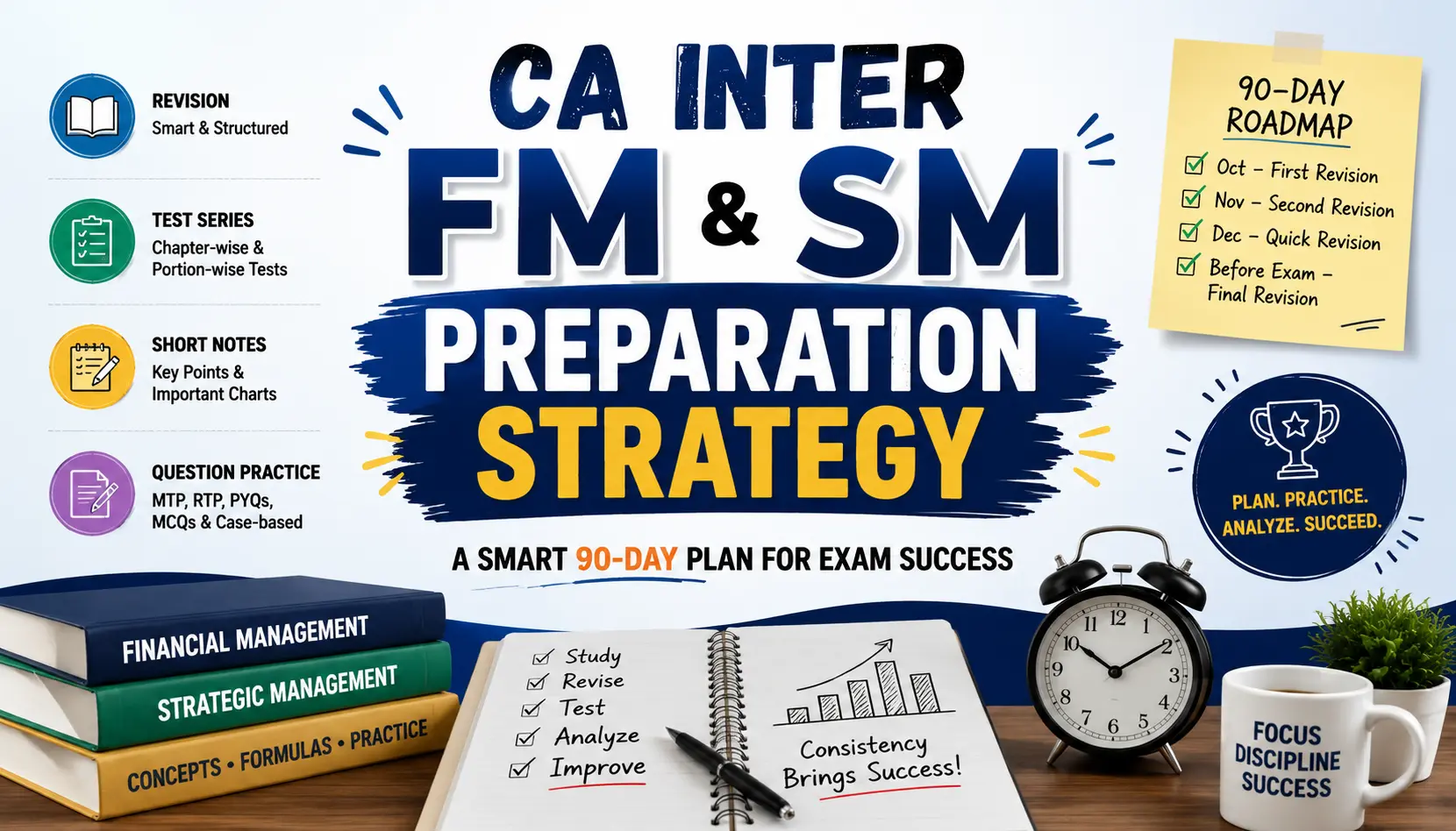
CA Inter FM & SM Preparation Strategy

Preparing for CA Inter FM & SM can become confusing when the exam is getting closer and you are still trying to decide what to study, when to revise, and how many tests to attempt. The biggest mistake at this stage is spending too much time looking for new strategies instead of actually following one. If you have around 90 days on the calendar, remember that you do not really have 90 completely productive study days. Festivals, personal commitments, unexpected situations and buffer days can affect your schedule. So, instead of planning every single day tightly, make a realistic plan that gives you some breathing space. The basic strategy for FM & SM remains the same whether you are preparing for one group, both groups, or even focusing on an individual subject. The difference is mainly in the amount of effort and time you need to put in. So, let’s break the preparation into a simple revision plan. What Should Be Your Main Focus for CA Inter FM & SM? Your preparation should not be limited to completing the chapters. A good preparation cycle should include: Completing the course First revision Chapter-wise tests Second revision Portion-wise tests Short notes and charts Quick revision Question practice Full-paper tests Final revision before the exam The idea is simple: study, revise, test yourself, find your weak areas and revise them again. First, Make Sure Your Course Is Completed Before planning multiple revisions, check whether your FM & SM course is actually complete. If your course is already finished, you can directly focus on revision and testing. But if your lectures are still pending, the situation is different. You now have to manage both things together: Course completion + Revision In that case, set a short and clear target for completing the remaining lectures. Do not keep stretching the course completion for too long. At the same time, do not completely forget the portion you have already studied. This is where your planning becomes important. You need to continue moving forward with the remaining lectures while making sure that the previously completed portion does not disappear from your preparation. First Revision: Focus on Understanding and Chapter-Wise Tests Your first proper revision should be detailed. This is the stage where you should go through the chapters properly rather than trying to finish everything as quickly as possible. But there is one important thing you should do along with revision: Give a test after completing a chapter. For example, if you finish a chapter in FM, give its chapter-wise test after completing it. This gives you a clear idea of whether you actually remember what you studied. Your first revision should look like this: Chapter → Revision → Chapter-wise Test → Check Mistakes → Move Ahead Do not just read the chapter and immediately move to the next one. The test is an important part of the revision itself. Why Chapter-Wise Tests Matter When you study a chapter, it can feel like everything is clear. The real test comes when you sit down and solve questions without looking at the material. That is why chapter-wise tests should be included in your first revision. They help you identify the areas where you are still struggling. If you make a mistake in a particular concept, calculation or question, mark it and keep it in mind for your next revision. This way, your revision becomes more focused every time. Second Revision: Increase Your Speed Once the first revision is complete, your second revision should be faster. You should not spend the same amount of time on every chapter that you spent during the first revision. For example, if you covered one chapter in a day during the first revision, you should try to cover more than one chapter during the second revision, depending on your overall schedule. The reason is simple. You have already studied the chapters once. Now you need to recall and revise them faster. But this time, the test pattern should also change. Instead of giving only chapter-wise tests, start giving portion-wise tests. What Is a Portion-Wise Test? A portion-wise test means combining multiple chapters and testing them together. For example, after revising three chapters, instead of giving three separate tests, you can attempt one test covering that portion. This gives you a different level of practice because you are no longer solving questions while thinking only about one particular chapter. You have to identify which concept or chapter the question belongs to and then solve it. This is why the progression from chapter-wise tests to portion-wise tests is important in the preparation plan. Use Your Second Revision to Make Short Notes Your second revision is also the right time to identify your weak points. While revising, ask yourself: Where am I getting confused? Which concept do I keep forgetting? Which formula or point needs quick revision? Which topic takes more time to recall? Make short notes or charts for these areas. You do not need to rewrite the entire chapter. The purpose of these notes is to make your future revision quicker. When you reach the final stage of preparation, these notes can help you revise important points without going through everything from the beginning. Third Revision: Quick and Focused Revision After completing the first and second revisions, your third revision should be much quicker. This is where your short notes and charts become useful. The idea is not to sit and study every chapter in the same detailed way again. Instead, revise the important points quickly and focus on the areas that you have already identified as difficult. The target is to complete this quick revision within the planned time rather than allowing it to continue indefinitely. At this stage, your preparation should feel much more familiar than it did during the first revision. How to Prepare FM Differently from SM? FM and SM require a slightly different approach during revision. Financial Management: Give More Time to Question Practice In FM, question practice

Uncategorized

What to Look for in Articleship by CA Students? 

Articleship is one of the most important phases in a CA student’s journey. It is where theoretical knowledge meets practical exposure, helping students understand how the profession works in the real world. Choosing the right articleship can shape your learning, confidence, technical skills, and future career opportunities. Many students become anxious after completing their CA Intermediate examinations because they are unsure about where to apply, which firm to choose, and what skills they should develop before starting. The key is not to rush the decision. Instead, take time to understand your career goals and evaluate your options carefully. This guide explains the essential factors every CA student should consider before selecting an articleship and how proper planning can help build a successful career. Why Choosing the Right Articleship Matters Articleship is more than just a mandatory training period. It gives students practical experience in accounting, auditing, taxation, compliance, client communication, and professional ethics. The quality of this learning depends largely on the organization where the training is completed. A well-chosen articleship helps students: Gain practical exposure to real business situations Develop technical and professional skills Improve confidence while working with clients Prepare better for CA Final examinations Build a strong professional network For this reason, students should begin planning even before their examination results are announced rather than waiting until the last moment. Start with Career Clarity Before applying anywhere, ask yourself one important question: What kind of learning experience do I want from my articleship? Generally, students compare opportunities between larger firms and mid-sized firms. Instead of following trends, evaluate each option based on your own priorities. Create a simple list of advantages and challenges for every firm you are considering. Compare factors such as learning opportunities, work culture, exposure, study balance, location, and future career goals. This approach helps make a practical decision instead of an emotional one. Practical Exposure Should Be Your Priority One of the biggest objectives of articleship is learning practical work. A good training environment should expose students to different areas such as: Statutory Audit Internal Audit Stock Audit Taxation GST Compliance Income Tax Returns TDS Compliance Financial Reporting Client Documentation Exposure to multiple domains allows students to discover their strengths while building a solid professional foundation. Balance Learning with CA Final Preparation While practical experience is essential, students should also consider whether the work environment allows sufficient time for self-study. Articleship and CA Final preparation go hand in hand. A healthy work-life balance helps students remain productive without compromising either practical learning or examination preparation. Instead of choosing only based on a firm’s reputation, evaluate whether the overall environment supports long-term professional growth. Research Before Applying Good research can save students from making the wrong decision. Look for information about: Nature of work Learning opportunities Work culture Type of clients handled Training quality Professional guidance available Connecting with current or former trainees can provide valuable insights into the actual working environment. Their experiences often help students understand what to realistically expect before joining. Build a Professional Network Networking has become an important part of career development. Creating a professional profile, connecting with industry professionals, and participating in career discussions can help students discover opportunities that may not always be publicly advertised. Professional networking also allows students to: Learn about different firms Understand recruitment processes Receive career guidance Build meaningful industry connections Strong professional relationships can become valuable throughout a CA career. Skills Every CA Student Should Learn Before Articleship Technical knowledge alone is not enough. Students should develop practical workplace skills before joining articleship. 1. Microsoft Excel Excel remains one of the most frequently used tools in accounting and finance. Students should understand: Basic formulas Data sorting Filters Tables Basic financial calculations Data organization Even basic Excel proficiency makes day-to-day work significantly easier. 2. Microsoft Office Apart from Excel, familiarity with Word and PowerPoint helps in preparing reports, documentation, and client presentations. 3. AI Productivity Tools Modern workplaces increasingly use AI-powered tools to improve productivity. Learning how to responsibly use AI for documentation, summarization, presentation preparation, and information organization can improve efficiency while supporting professional work. Focus on Learning, Not Just Brand Names Many students believe that joining a well-known organization automatically guarantees success. However, the quality of learning depends on the responsibilities assigned, mentorship available, and practical exposure received. A smaller firm may provide experience across multiple domains, while another organization may offer specialization in a specific area. The right choice depends on your career objectives rather than popularity alone.READ MORE: Looking for the right guidance to build a successful CA career? Explore Make an Informed Decision Choosing an articleship is a personal decision. Every student’s goals, strengths, and learning preferences are different. Before accepting an offer, evaluate: Learning opportunities Practical exposure Work culture Study balance Skill development Long-term career goals Taking time to research these factors can help students make a confident and well-informed decision. Conclusion choosing the right articleship is one of the most important decisions in a CA student’s professional journey. It is not just about joining a well-known firm—it is about finding an environment where you can learn, grow, and build practical skills that will benefit you throughout your career. At CA Jitin Tyagi Classes . Before making your decision, take time to research different firms, understand the type of work they offer, evaluate the learning opportunities, and identify which option best aligns with your long-term career goals. Developing essential skills like Microsoft Excel, communication, and professional networking before joining can also give you a significant advantage. Remember, every student’s career path is different. The best articleship is the one that helps you gain meaningful practical exposure while allowing you to continue your CA Final preparation effectively. A well-informed decision today can become the foundation of a successful Chartered Accountant career tomorrow. Invest your time in choosing wisely, stay committed to continuous learning, and make the most of every opportunity that comes your way. Frequently Asked Questions (FAQs) What should CA students look for in an articleship?

Blogs

CA Inter Taxation Exam Review – What to Expect

Preparing for the CA Inter Taxation examination requires much more than memorizing concepts. The subject demands a clear understanding of taxation principles, the ability to interpret questions correctly, and the confidence to apply knowledge in practical situations. Since the paper includes both conceptual and application-based questions, students often find it challenging to balance speed with accuracy. After the examination, one of the most common questions students ask is, “Was the paper easy or difficult?” While this is a natural concern, the answer is not always straightforward. The overall quality of an attempt depends on several factors, including conceptual understanding, question analysis, time management, and answer presentation. Therefore, evaluating the paper based only on its difficulty level may not provide an accurate picture of your performance. What Should You Expect from the CA Inter Taxation Exam? The CA Inter Taxation examination is designed to test both theoretical knowledge and practical application. Instead of relying only on memorized provisions, students are expected to understand the logic behind taxation concepts and apply them correctly in different scenarios. The examination may include a combination of direct, conceptual, and application-oriented questions. Some questions may appear familiar, while others may require deeper analysis and careful interpretation. This approach evaluates not only a student’s knowledge but also their ability to think logically under examination conditions. Understanding the Difficulty Level Every student experiences the examination differently. A candidate who has revised the syllabus thoroughly and practiced a variety of questions may find the paper manageable. On the other hand, students who are less confident with calculations or practical applications may feel that the same paper is more challenging. Instead of comparing your experience with others, it is better to review your own attempt objectively. Consider whether the questions were based on familiar concepts, whether calculations required additional time, and whether you were able to complete the paper comfortably within the allotted duration. A balanced review should focus on the nature of the questions, conceptual clarity, and overall paper management rather than simply labeling the paper as easy or difficult. Direct Tax and GST: Areas to Focus On A strong preparation strategy should give equal importance to both Direct Tax and GST. Each section requires conceptual understanding as well as the ability to apply provisions to practical situations. Rather than memorizing answers, students should focus on understanding why a provision is used and how it applies to different types of questions. A well-prepared student is generally more confident in approaching unfamiliar questions because a strong conceptual foundation helps in analysing situations logically. Regular revision and consistent question practice also improve confidence and reduce the chances of making avoidable mistakes during the examination. Why Time Management Matters Time management is one of the most important factors in the CA Inter Taxation examination. Even students who know the concepts well may struggle if they spend too much time on a single lengthy question. An effective strategy is to read each question carefully, understand its requirements, and allocate time according to the marks assigned. Questions involving calculations should be attempted in a structured manner, with clear workings wherever necessary. Maintaining a balance between speed and accuracy can significantly improve the overall quality of the attempt. Students should also avoid getting stuck on difficult questions. Moving ahead and returning later, if time permits, often results in a more balanced and complete paper. How to Evaluate Your Performance Once the examination is over, students naturally begin estimating their performance. However, evaluating an exam should involve more than simply counting attempted questions. Ask yourself the following: Were your answers conceptually correct? Did you apply the provisions accurately? Were your calculations presented clearly? Did you complete the paper within the given time? Did you avoid unnecessary mistakes? Even if a few answers seem uncertain, there is no reason to assume that the overall result will be disappointing. A complete evaluation should consider accuracy, presentation, logical application of concepts, and the overall quality of the attempt. It is equally important not to compare your answers with every discussion after the exam. Different students may remember questions differently, and excessive comparison often creates unnecessary confusion.READ MORE: Looking for the right guidance to build a successful CA career? Explore   Best Preparation Strategy for Future Attempts Students preparing for future CA Inter Taxation examinations should focus on building conceptual clarity rather than relying only on memorization. Regular revision, solving practical questions, analysing previous examination patterns, and attempting mock tests can improve both confidence and examination performance. Mock tests are particularly valuable because they help students identify weak areas while improving speed and time management. Consistent practice also develops the ability to approach different question formats with confidence. A balanced study plan that combines revision, practical application, and regular self-assessment is generally more effective than last-minute preparation. Key Takeaway Success in the CA Inter Taxation examination depends on much more than completing the syllabus. Students who understand concepts, practise consistently, manage their time effectively, and present answers in a structured manner are usually better prepared to handle the examination confidently. Instead of focusing only on whether the paper was easy or difficult, analyse your own performance objectively and identify areas for improvement. Every examination provides an opportunity to strengthen concepts and refine your preparation strategy. Conclusion The CA Inter Taxation examination is designed to test both knowledge and application. At CA Jitin Tyagi Classes, Students who prepare with conceptual clarity, regular revision, and practical practice are better equipped to perform confidently. Whether you have already appeared for the examination or are preparing for an upcoming attempt, focusing on consistent learning, structured practice, and effective time management can make a significant difference in your overall performance. Frequently Asked Questions (FAQs) Is the CA Inter Taxation exam only based on theory? No. The examination assesses both conceptual understanding and the practical application of taxation provisions in different situations. How should students review their performance after the exam? Students should evaluate their attempt based on conceptual accuracy, calculations, time management, answer presentation,