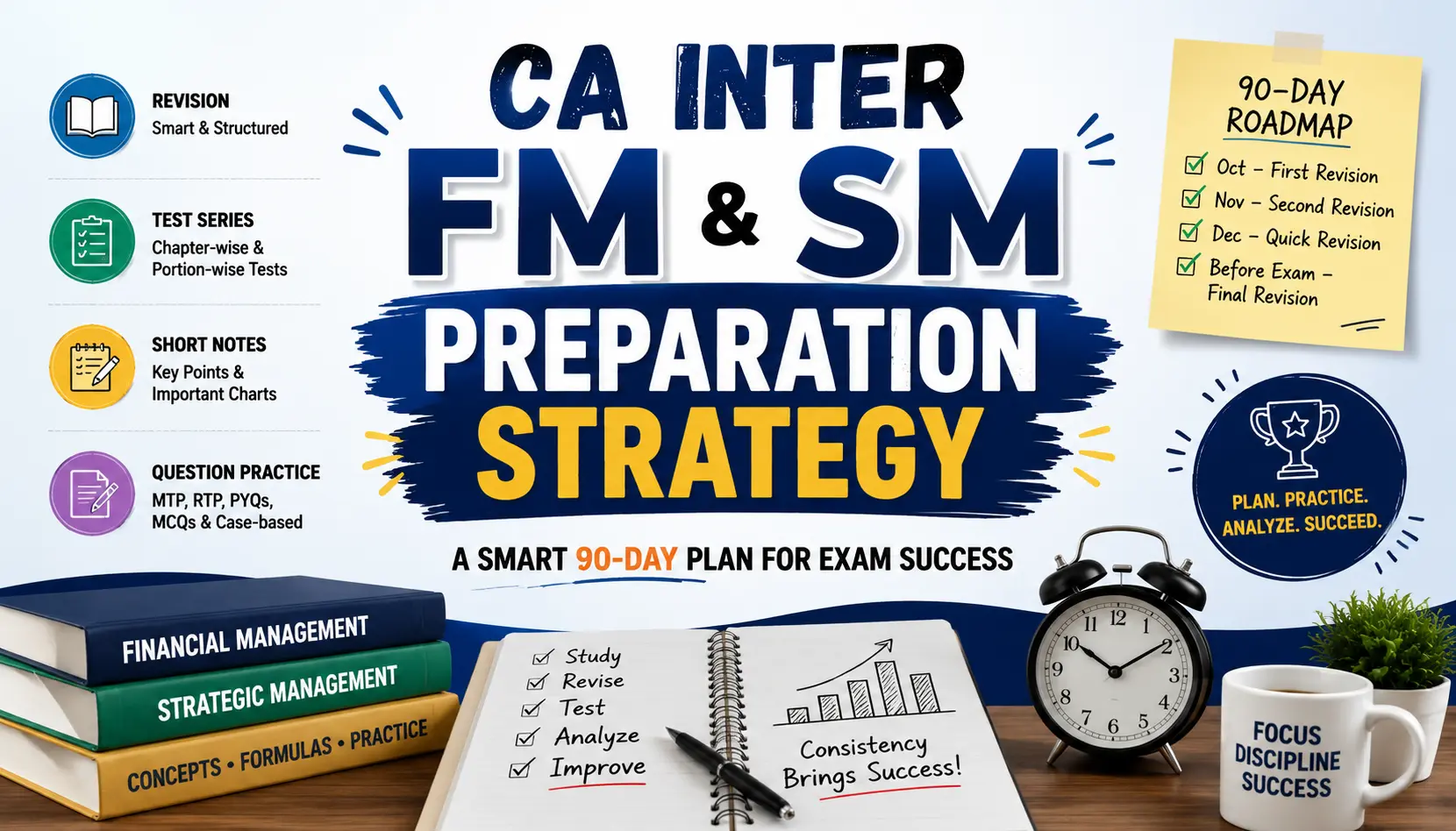
Preparing for CA Inter FM & SM can become confusing when the exam is getting closer and you are still trying to decide what to study, when to revise, and how many tests to attempt.
The biggest mistake at this stage is spending too much time looking for new strategies instead of actually following one.
If you have around 90 days on the calendar, remember that you do not really have 90 completely productive study days. Festivals, personal commitments, unexpected situations and buffer days can affect your schedule. So, instead of planning every single day tightly, make a realistic plan that gives you some breathing space.
The basic strategy for FM & SM remains the same whether you are preparing for one group, both groups, or even focusing on an individual subject. The difference is mainly in the amount of effort and time you need to put in.
So, let’s break the preparation into a simple revision plan.
What Should Be Your Main Focus for CA Inter FM & SM?
Your preparation should not be limited to completing the chapters.
A good preparation cycle should include:
- Completing the course
- First revision
- Chapter-wise tests
- Second revision
- Portion-wise tests
- Short notes and charts
- Quick revision
- Question practice
- Full-paper tests
- Final revision before the exam
The idea is simple: study, revise, test yourself, find your weak areas and revise them again.
First, Make Sure Your Course Is Completed
Before planning multiple revisions, check whether your FM & SM course is actually complete.
If your course is already finished, you can directly focus on revision and testing.
But if your lectures are still pending, the situation is different. You now have to manage both things together:
Course completion + Revision
In that case, set a short and clear target for completing the remaining lectures. Do not keep stretching the course completion for too long.
At the same time, do not completely forget the portion you have already studied.
This is where your planning becomes important.
You need to continue moving forward with the remaining lectures while making sure that the previously completed portion does not disappear from your preparation.
First Revision: Focus on Understanding and Chapter-Wise Tests
Your first proper revision should be detailed.
This is the stage where you should go through the chapters properly rather than trying to finish everything as quickly as possible.
But there is one important thing you should do along with revision:
Give a test after completing a chapter.
For example, if you finish a chapter in FM, give its chapter-wise test after completing it.
This gives you a clear idea of whether you actually remember what you studied.
Your first revision should look like this:
Chapter → Revision → Chapter-wise Test → Check Mistakes → Move Ahead
Do not just read the chapter and immediately move to the next one.
The test is an important part of the revision itself.
Why Chapter-Wise Tests Matter
When you study a chapter, it can feel like everything is clear.
The real test comes when you sit down and solve questions without looking at the material.
That is why chapter-wise tests should be included in your first revision.
They help you identify the areas where you are still struggling.
If you make a mistake in a particular concept, calculation or question, mark it and keep it in mind for your next revision.
This way, your revision becomes more focused every time.
Second Revision: Increase Your Speed
Once the first revision is complete, your second revision should be faster.
You should not spend the same amount of time on every chapter that you spent during the first revision.
For example, if you covered one chapter in a day during the first revision, you should try to cover more than one chapter during the second revision, depending on your overall schedule.
The reason is simple.
You have already studied the chapters once. Now you need to recall and revise them faster.
But this time, the test pattern should also change.
Instead of giving only chapter-wise tests, start giving portion-wise tests.
What Is a Portion-Wise Test?
A portion-wise test means combining multiple chapters and testing them together.
For example, after revising three chapters, instead of giving three separate tests, you can attempt one test covering that portion.
This gives you a different level of practice because you are no longer solving questions while thinking only about one particular chapter.
You have to identify which concept or chapter the question belongs to and then solve it.
This is why the progression from chapter-wise tests to portion-wise tests is important in the preparation plan.
Use Your Second Revision to Make Short Notes
Your second revision is also the right time to identify your weak points.
While revising, ask yourself:
- Where am I getting confused?
- Which concept do I keep forgetting?
- Which formula or point needs quick revision?
- Which topic takes more time to recall?
Make short notes or charts for these areas.
You do not need to rewrite the entire chapter.
The purpose of these notes is to make your future revision quicker.
When you reach the final stage of preparation, these notes can help you revise important points without going through everything from the beginning.
Third Revision: Quick and Focused Revision
After completing the first and second revisions, your third revision should be much quicker.
This is where your short notes and charts become useful.
The idea is not to sit and study every chapter in the same detailed way again.
Instead, revise the important points quickly and focus on the areas that you have already identified as difficult.
The target is to complete this quick revision within the planned time rather than allowing it to continue indefinitely.
At this stage, your preparation should feel much more familiar than it did during the first revision.
How to Prepare FM Differently from SM?
FM and SM require a slightly different approach during revision.
Financial Management: Give More Time to Question Practice
In FM, question practice is an important part of preparation.
You cannot depend only on reading the concepts.
Along with revision, you should keep solving questions and taking tests.
Your FM preparation should include:
- Chapter-wise practice
- Portion-wise tests
- Study Material questions
- MTP questions
- RTP questions
- Previous Year Questions
- MCQs
- Case-based questions
- Full-paper tests
The more you move towards the exam, the more important question practice becomes.
Strategic Management: Focus on Keywords
SM can be revised comparatively faster, but you should pay attention to the important keywords.
While studying SM, make it a habit to write important terms and keywords.
For example, when you study a framework or concept, identify the important words that you need to remember.
You can also prepare short notes or charts for quick revision.
The purpose is to make your SM revision easier when you have very limited time before the exam.
Full-Paper Tests Before the Exam
After chapter-wise and portion-wise tests, you should move towards full-paper practice.
The strategy suggests keeping a target of at least three full-paper tests.
A full-paper test is different from a chapter test because you have to handle the complete paper.
After completing each full paper, do not stop at checking your marks.
Spend time analysing the paper.
Look at:
- Questions you could not solve
- Questions where you made mistakes
- Areas where you lost marks
- Topics that still need revision
- Problems that appeared repeatedly
Then use this analysis during your next revision.
SM can be revised comparatively faster, but you should pay attention to the important keywords.
While studying SM, make it a habit to write important terms and keywords.
For example, when you study a framework or concept, identify the important words that you need to remember.
You can also prepare short notes or charts for quick revision.
The purpose is to make your SM revision easier when you have very limited time before the exam.
READ MORE: Looking for the right guidance to build a successful CA career? Explore
Is It Necessary to Study for 15–17 Hours Every Day?
The strategy does not recommend making extremely long study hours the main target.
The focus should instead be on how effectively you use your available study time.
The important thing is to create a routine that you can actually follow.
Studying for a very large number of hours on paper does not automatically mean that the preparation will be better.
Your target should be consistent and focused study.
A Simple 90-Day FM & SM Roadmap
You can understand the complete strategy through four major stages.
October — First Revision
Focus on:
- Complete revision
- Detailed study
- Chapter-wise tests
- Identifying weak areas
- Starting short notes and charts
November — Second Revision
Focus on:
- Faster revision
- Multiple chapters together
- Portion-wise tests
- Identifying repeated mistakes
- Preparing useful short notes and charts
December — Quick Revision
Focus on:
- Quick revision through charts and notes
- FM question practice
- SM keyword revision
- MTP, RTP and Previous Year Questions
- MCQs and case-based questions
Before the Exam — Final Revision
Focus on:
- Quick revision
- Important points
- Short notes
- Weak areas
- Full-paper tests
- Final analysis
CA Inter FM & SM Preparation Checklist
Before the exam, check whether you have completed the following:
- Course completed
- First revision completed
- Chapter-wise tests attempted
- Second revision completed
- Portion-wise tests attempted
- Short notes/charts prepared
- FM question practice completed
- SM keywords revised
- Study Material questions practiced
- MTP practiced
- RTP practiced
- Previous Year Questions practiced
- MCQs practiced
- Case-based questions practiced
- At least three full-paper tests attempted
- Test mistakes analysed
- Final quick revision completed
Final Thoughts
CA Inter FM & SM preparation is not about finding a perfect timetable. It is about having a clear plan and actually following it.
Start with a detailed first revision and chapter-wise tests. Move towards a faster second revision with portion-wise tests. Then use your short notes and charts for quick revision, continue your question practice and complete full-paper tests before the exam.
For FM, keep your question practice strong. For SM, focus on concepts, keywords and quick revision.
And most importantly, do not spend all your time watching preparation strategies.
Choose your plan, start studying, keep testing yourself and keep improving your weak areas.
The strategy is simple:
Revise → Test → Analyse → Improve → Revise Again.
That is the approach you need to carry throughout your CA Inter FM & SM preparation.
Frequently Asked Questions (FAQs)
Focus strongly on question practice along with revision. Include Study Material, MTP, RTP, Previous Year Questions, MCQs, case-based questions and tests.
Focus on important concepts and keywords. Writing important keywords and preparing short notes or charts can help during quick revision.
The strategy suggests targeting three proper revisions, followed by another quick revision before the examination.
Focus on detailed revision and give chapter-wise tests after completing the chapters.