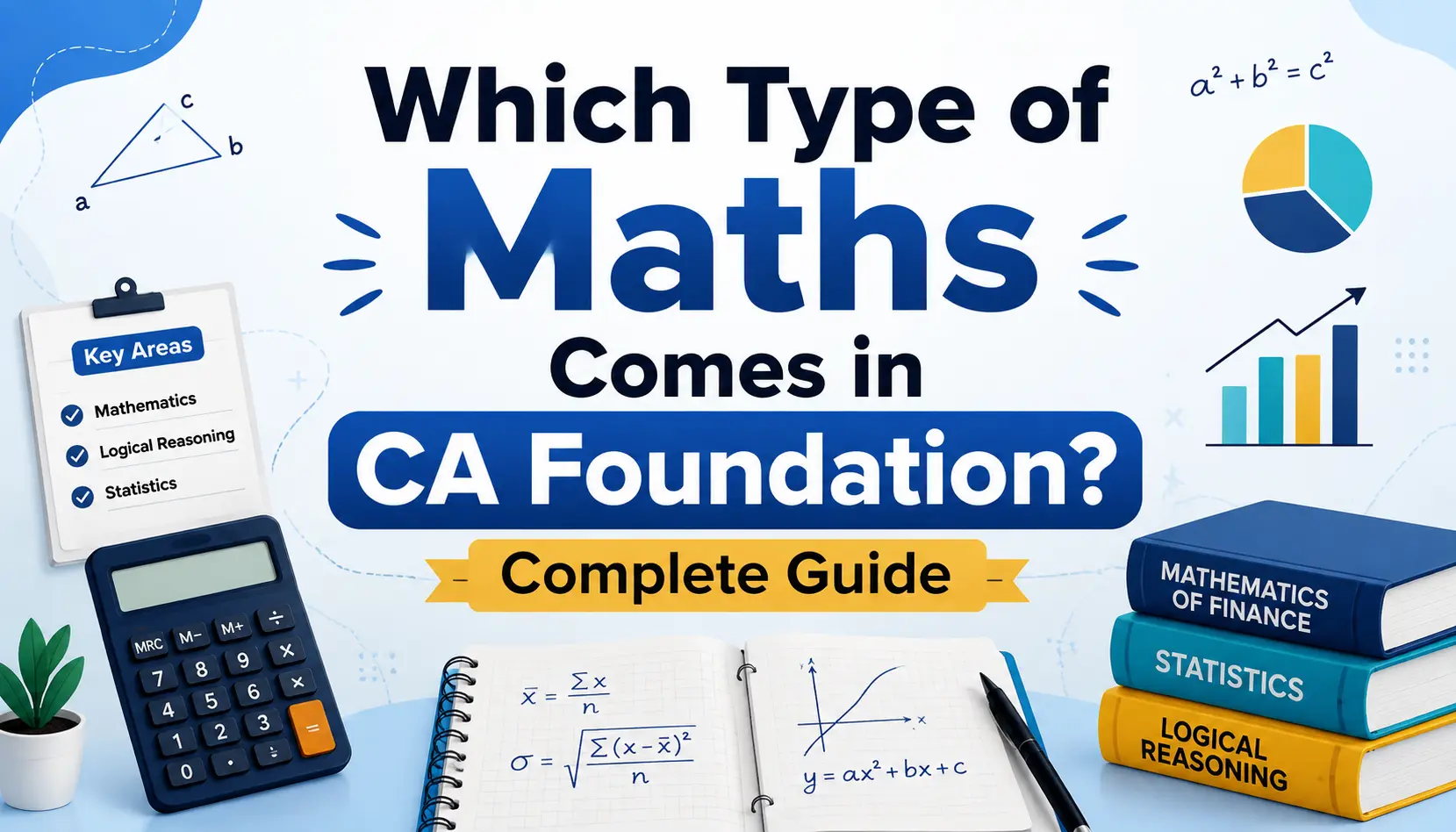
Students preparing for CA Foundation often ask, “Which type of Maths comes in CA Foundation?” Many students, especially those from a non-mathematics background, feel that the subject may be difficult. However, CA Foundation Maths is not only about complicated calculations. It is a combination of Mathematics, Logical Reasoning, and Statistics, where speed, accuracy, formulas, and smart question selection play an important role.
With the right preparation strategy, students can make the subject more manageable and aim for a strong score.
Quick Answer
CA Foundation Maths mainly includes three areas: Mathematics, Logical Reasoning, and Statistics. Important topics include Mathematics of Finance, Ratio, Proportion and Logarithms, Sequence and Series, Measures of Central Tendency and Dispersion, Statistical Description of Data, Index Numbers, and Correlation and Regression. The paper also requires strong formula knowledge, calculation speed, accuracy, and smart question selection.
For better performance, students should prioritise important chapters, maintain a chapter-wise formula bank, practise questions regularly, take timed mock tests, and avoid unnecessary guessing because accuracy is important for controlling negative marking.
What Type of Maths Is Asked in CA Foundation?
CA Foundation Maths can broadly be understood through three areas:
- Logical Reasoning
- Mathematics
- Statistics
Each section requires a different preparation approach. Logical Reasoning mainly tests logical thinking, while Mathematics involves calculation and formula application. Statistics is also largely formula-based and requires regular practice.
Therefore, students should not prepare every part of the paper in exactly the same way.
Logical Reasoning: A Scoring Area
Logical Reasoning can be a useful scoring area because it does not depend heavily on traditional mathematical calculations. The focus is mainly on understanding patterns, applying logic, and selecting the correct answer.
The source discussion highlights Logical Reasoning as an important part of the paper and suggests targeting a strong score from this section.
For students who are uncomfortable with Mathematics, Logical Reasoning can provide an opportunity to build confidence and improve their overall performance.
Important Mathematics Chapters
Some Mathematics chapters can be given higher priority during preparation.
Mathematics of Finance
Mathematics of Finance is one of the important chapters discussed in the source. It is described as a largely calculator-based area and can contribute around 12–15 marks.
Students should focus on understanding the formulas and practising calculations repeatedly. Calculator practice can also help improve speed and accuracy.
Ratio, Proportion and Logarithms
This chapter can contribute around 5–7 marks according to the discussion. Students with a basic understanding of the concepts can improve their performance through regular practice.
Sequence and Series
Sequence and Series is another useful chapter and is discussed as an area that can contribute around 4–6 marks.
When combined with other important chapters, these topics can form a significant part of a student’s Mathematics preparation.
Important Statistics Chapters
Statistics is another major area that students should prepare carefully.
Measures of Central Tendency and Dispersion
This is described as one of the important chapters in Statistics. Although the chapter may be lengthy, it is largely formula-based. The discussion suggests that it can contribute around 12–15 marks.
Students should understand the formulas and practise their application through questions.
Statistical Description of Data
Statistical Description of Data is another important topic, with around 5–6 marks discussed as a possible contribution.
Index Numbers
Index Numbers is also included among the important areas. Along with formulas, students need to understand the basic logic behind the questions.
Correlation and Regression
Correlation and Regression is discussed as a formula-based topic that can contribute around 10–15 marks. Instead of being afraid of this chapter, students should focus on learning the formulas and practising their application.
Is a Formula Bank Important for CA Foundation Maths?
Yes, a formula bank can be extremely useful for revision.
Students can maintain chapter-wise formula notes containing important formulas and examples. A well-organised formula summary can make revision faster, particularly before examinations.
The source discussion also highlights the usefulness of chapter-wise summary notes for quick revision and formula recall.
Why Are Speed and Accuracy Important?
CA Foundation Maths is not only a knowledge-based paper. Speed and accuracy matter significantly.
The discussion describes a situation of 120 minutes and 100 questions, making time management an important part of examination strategy.
Students should practise solving questions within a fixed time rather than spending unlimited time on individual problems.
How to Avoid Negative Marking?
Accuracy is just as important as attempting questions.
Students may solve many questions correctly but still lose marks through unnecessary guessing. Therefore, every question does not need to be attempted.
A practical approach is to first solve questions where the answer is clear, then move towards questions where options can be logically eliminated. Questions involving excessive uncertainty should be handled carefully.
The objective should be maximum accuracy rather than maximum guessing.
How Should You Prepare for CA Foundation Maths?
A simple preparation strategy can include:
- Prioritise important chapters.
- Prepare a chapter-wise formula bank.
- Practise questions regularly.
- Improve calculator and calculation speed.
- Take mock tests under time limits.
- Analyse mistakes after every test.
- Focus on avoiding unnecessary negative marking.
Final Takeaway
CA Foundation Maths is a combination of Logical Reasoning, Mathematics, and Statistics. Important areas include Mathematics of Finance, Ratio and Proportion, Logarithms, Sequence and Series, Measures of Central Tendency and Dispersion, Statistical Description of Data, Index Numbers, and Correlation and Regression.
Students do not need to approach the subject with fear. A focused strategy based on important chapters, formula revision, question practice, speed, accuracy, and mock tests can make preparation more organised.
For students who need additional support, choosing the right CA coaching and professor can also make the preparation journey more structured. Proper coaching guidance can help students understand available classes, compare suitable options, and select learning support according to their individual preparation needs.
Frequently Asked Questions (FAQs)
CA Foundation Maths broadly includes Mathematics, Logical Reasoning, and Statistics. Mathematics includes calculation and formula-based topics, while Logical Reasoning focuses on logical thinking and Statistics involves formula-based concepts and calculations.
Important chapters discussed in the source include Mathematics of Finance, Ratio, Proportion and Logarithms, Sequence and Series, Measures of Central Tendency and Dispersion, Statistical Description of Data, Index Numbers, and Correlation and Regression.
Yes. Mathematics of Finance is highlighted as an important chapter in the source discussion and is described as a largely calculator-based topic. The discussion indicates an approximate contribution of 12–15 marks.
A non-mathematics background does not necessarily prevent a student from performing well. The source emphasises speed, accuracy, formula preparation, question practice and smart examination strategy as important factors.
Focus on important chapters first, prepare a chapter-wise formula bank, practise questions regularly, improve calculation speed, take timed mock tests and carefully analyse mistakes. Avoid unnecessary guessing to reduce the impact of negative marking.