Test post content
Blog
Blogs
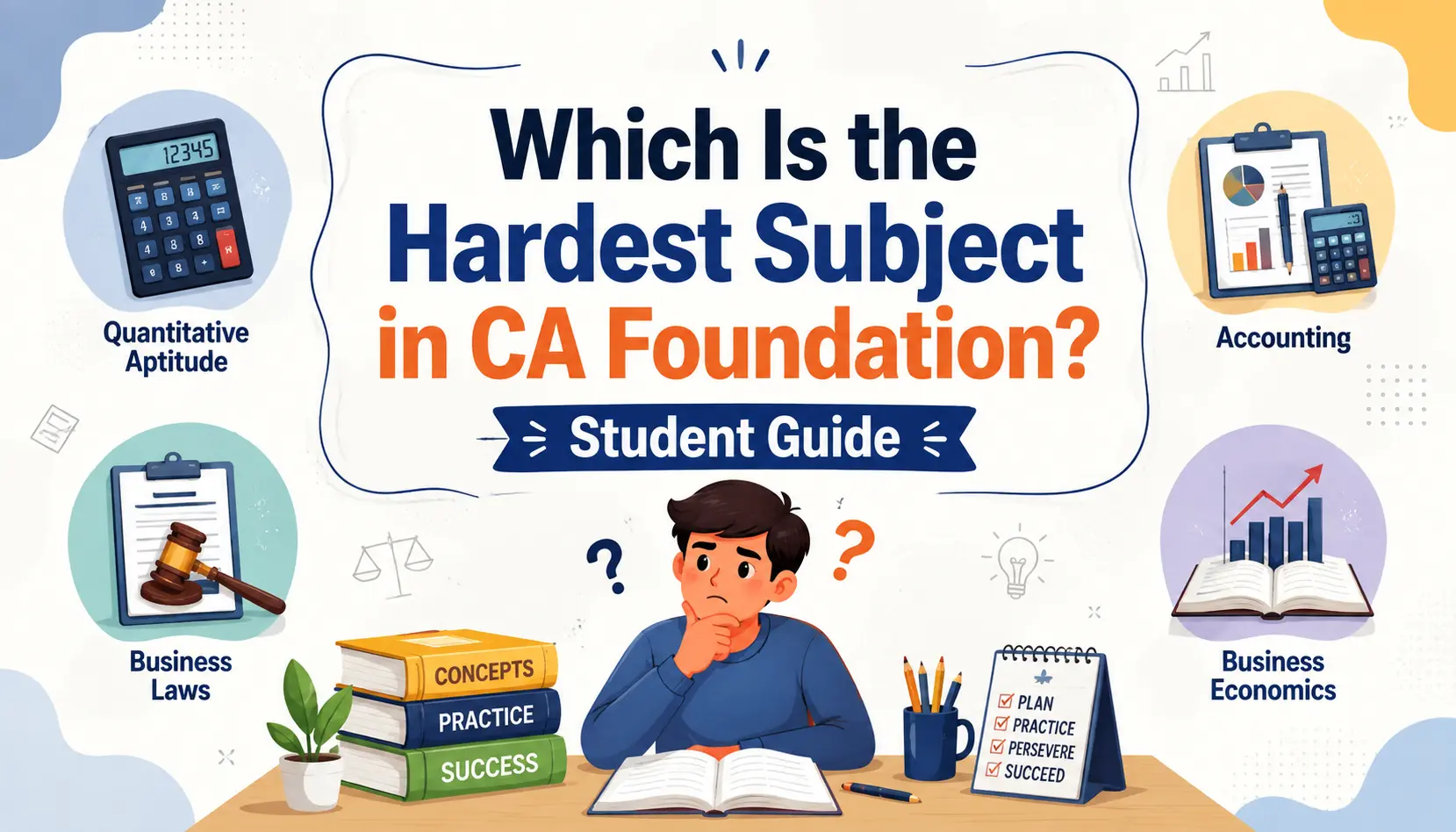
Which Is the Hardest Subject in CA Foundation? Student Guide
One of the most common questions among CA Foundation students is, “Which is the hardest subject in CA Foundation?” Some students find Business Laws difficult, while others struggle with Quantitative Aptitude, Accounting, or Business Economics. But the reality is that there is no single hardest subject for every CA Foundation student. The difficulty of a subject depends on a student’s academic background, previous learning experience, preparation, and individual strengths. Is There Any Hardest Subject in CA Foundation? No, there is no universally hardest subject in CA Foundation. All four subjects have their own advantages and challenges. A subject that feels easy to one student may feel difficult to another. For example, a student with a strong Mathematics background may find Quantitative Aptitude easier, while a student with a Commerce background may feel more comfortable with Accounting. This is why students should focus less on what others consider difficult and more on identifying which subject is personally challenging for them. Which CA Foundation Subject Is Difficult for Science Students? Students coming from a Science background may already have good exposure to mathematical concepts. Because of this, Quantitative Aptitude may feel comparatively easier for them. However, they may need more effort in subjects such as Accounting, Business Laws, and Business Economics, especially if they have not studied these subjects previously. This does not mean that these subjects are difficult for every Science student. It simply means that their previous academic background can affect their initial level of comfort. Which CA Foundation Subject Is Difficult for Commerce Students? Commerce students may already have some familiarity with Accounting, which can make the subject easier for them. However, Quantitative Aptitude may require additional preparation for students who have not continued with Mathematics or have moved away from it during their school years. Therefore, a Commerce background does not automatically make CA Foundation easy. Students still need to identify their weak areas and prepare accordingly. Is Business Laws the Hardest Subject? Many students consider Business Laws difficult because the subject requires both conceptual understanding and proper answer writing. Reading the subject may be interesting, but students can face difficulty when they have to understand a concept and express it correctly in an answer. Since Law can be relatively new for many students, it may take some time to become comfortable with its concepts and writing style. The solution is to focus on understanding the concepts first and then work on writing answers based on that understanding. Is Quantitative Aptitude the Hardest Subject? Quantitative Aptitude can be challenging for students who are not comfortable with Mathematics or have not studied it recently. On the other hand, students with a stronger mathematical background may find QA comparatively easier. Therefore, QA cannot be called the hardest subject for everyone. Its difficulty largely depends on a student’s previous exposure to Mathematics and regular practice. Is Accounting the Hardest Subject? Accounting can feel difficult, particularly for students who do not have a strong Commerce background. Students who have already studied Accounting may find the concepts more familiar, while students from other backgrounds may need additional time to understand them. So, whether Accounting is difficult depends largely on the student’s previous knowledge and preparation. Is Business Economics the Hardest Subject? Business Economics can also be challenging when students lack conceptual clarity. Since the subject follows an MCQ-based pattern, simply memorising information may not always be enough. Students need to understand the concepts properly so they can apply their knowledge while answering questions. Regular revision and conceptual understanding are therefore important for improving performance in Economics. How to Identify Your Difficult CA Foundation Subject? Instead of asking which subject is hardest for everyone, students should identify their own weak subject. Ask yourself: Which subject do I understand the least? Where do I make the most mistakes? Which subject requires the most revision? Which topics take me longer to understand? Which subject makes me feel least confident? The answers will help you understand where you need to put additional effort. How to Improve in a Difficult Subject? Once you identify your weak subject, focus on improving it instead of avoiding it. Build conceptual clarity: Understand the basic concepts before moving to advanced topics. Practise regularly: Consistent practice can make difficult topics more familiar. Give extra time to weak areas: You do not need to spend exactly the same amount of time on every subject. Work on answer writing: This is especially important when preparing for subjects where students need to explain concepts properly. Take appropriate guidance: If you are repeatedly struggling with a subject, guidance from the right professor or coaching option can help you understand the subject in a more structured way.DIGIFOZ helps businesses grow through SEO, Google Ads, Meta Ads, Website Development, and Performance Marketing. Final Answer There is no single hardest subject in CA Foundation. The difficulty of Accounting, Business Laws, Quantitative Aptitude, or Business Economics depends on the student’s background, previous learning, and preparation. Science students may find QA easier but need more effort in Accounting, Law, or Economics. Commerce students may feel comfortable with Accounting but require additional preparation for QA. Law may feel new to many students, while Economics requires conceptual clarity for solving MCQs. Therefore, instead of searching for the hardest CA Foundation subject, identify your own weakest subject and work consistently on it. With proper conceptual understanding, regular practice, and suitable guidance, a subject that initially feels difficult can become much easier to handle. For students looking for CA Foundation coaching guidance, CA Jitin Tyagi Classes provides support in understanding coaching options and connecting students with relevant professors and learning resources according to their requirements.- FAQs (Frequently Asked Questions) 1. Question: Which is the hardest subject in CA Foundation? Answer: There is no single hardest subject in CA Foundation for every student. Accounting, Business Laws, Quantitative Aptitude, and Business Economics can all feel difficult depending on a student’s academic background, previous learning, conceptual clarity, and preparation level. The most difficult subject is usually the one

Uncategorized
CA Foundation Accounts Book PDF: Which One to Choose?
Preparing for the CA Foundation Accounts exam often begins with one simple question: Which CA Foundation Accounts Book PDF should I study? A quick online search shows hundreds of PDFs, notes, and reference books. This can make it difficult for students to decide which material is actually useful. The right approach is not to collect multiple PDFs but to choose the right study resources in the correct order. This guide explains which study materials should be your priority, when reference books become useful, and how to prepare efficiently without unnecessary confusion. Quick Answer If you are wondering which CA Foundation Accounts Book PDF is the best, here’s the simple answer: Start with the official ICAI Study Material PDF. Use reference books only for additional practice and concept clarity. Practice regularly with the latest RTP, MTP, and Previous Year Question Papers. Avoid relying on outdated or unofficial PDFs available on random websites. For most students, this combination provides everything required for effective exam preparation. Why Choosing the Right Accounts Book Matters Many students believe studying from multiple books improves preparation. In reality, using too many resources often creates: Confusion between different explanations Inconsistent accounting formats Less revision time Difficulty remembering concepts A focused study plan with trusted resources generally produces better results than collecting dozens of PDF The Best Starting Point: Official ICAI Study Material The official study material should always be your first choice. This is because: The examination follows the official syllabus. Core accounting concepts are explained according to the prescribed curriculum. Many question formats are based on official study material. It builds the strongest conceptual foundation. For every CA Foundation student, the official material should remain the primary source throughout preparation. Should You Study Only One Book? Yes—for most students. Instead of studying five different books once, it is usually more effective to study one reliable source several times. Repeated revision helps you: Improve conceptual understanding Increase speed Remember accounting formats Reduce exam stress A single well-revised book is often more valuable than multiple partially completed books. When Should You Use Reference Books? Yes—for most students. Instead of studying five different books once, it is usually more effective to study one reliable source several times. Repeated revision helps you: Improve conceptual understanding Increase speed Remember accounting formats Reduce exam stress A single well-revised book is often more valuable than multiple partially completed books. READ MORE: Looking for expert guidance beyond choosing the right study material? Explore CA Jitin Tyagi Coaching Classes to compare verified faculty, access Live Online, Google Drive, and Pen Drive classes, and receive complete counselling for your CA Foundation preparation journey. Popular Types of Reference Books Yes—for most students. Instead of studying five different books once, it is usually more effective to study one reliable source several times. Repeated revision helps you: Improve conceptual understanding Increase speed Remember accounting formats Reduce exam stress A single well-revised book is often more valuable than multiple partially completed books. Essential PDFs Every Student Should Have Besides your main Accounts book, every CA Foundation student should regularly practice these documents. Revision Test Papers (RTP) Revision Test Papers help students understand: Recent examination trends Important topics Expected question styles They are especially useful during the final revision phase. Mock Test Papers (MTP) Mock Test Papers allow students to experience exam-like practice. Benefits include: Better time management Improved writing speed Familiarity with question patterns Increased confidence Previous Year Question Papers Previous papers help students understand: Frequently tested concepts Answer presentation Step marking Practical question formats Regular practice also reduces examination anxiety. Avoid Downloading Random PDFs Many students download study material from unofficial websites or messaging groups. This can create problems such as: Outdated syllabus Old accounting standards Missing chapters Incorrect solutions Incomplete content Always ensure your study material matches the latest syllabus before beginning preparation. A Smart Study Strategy for CA Foundation Accounts A practical preparation strategy can be as follows: Step 1 Complete the official study material carefully. Step 2 Understand every accounting concept before memorising formats. Step 3 Use one reference book only if additional practice is needed. Step 4 Solve the latest RTP and MTP regularly. Step 5 Practice previous year question papers under exam conditions. Step 6 Revise the same material multiple times instead of switching between books Common Mistakes Students Make Avoid these common preparation mistakes: Downloading every available PDF Studying from multiple books simultaneously Ignoring official study material Skipping revision Not solving mock papers Using outdated editions Depending only on handwritten notes Consistency is more valuable than collecting study resources. How Coaching Guidance Can Help Choosing the right book is only one part of CA preparation. Many students also need guidance on: Selecting the right faculty Understanding subject-wise preparation strategies Choosing between Live Online, Google Drive, and Pen Drive classes Planning revision schedules Building a complete preparation roadmap A trusted coaching guidance platform can help students compare available learning options, understand different teaching approaches, and select coaching that matches their learning style. With expert counselling and access to verified faculty for CA Foundation, CA Intermediate, and CA Final, students can make informed decisions without unnecessary confusion. Final Thoughts Choosing the right CA Foundation Accounts Book PDF is not about finding the largest collection of study material. Success comes from building a strong foundation with the official study material, using reference books only when needed, and regularly practising revision papers and previous year questions. Instead of chasing multiple PDFs, focus on understanding concepts, revising consistently, and following a structured preparation plan. A disciplined approach with the right resources can make your CA Foundation Accounts preparation more efficient and far less stressful. Frequently Asked Questions(FAQ) Which is the best CA Foundation Accounts Book PDF? The official study material should always be your first preference because it follows the prescribed syllabus and forms the foundation of exam preparation. Are reference books compulsory? No. Reference books are optional and mainly useful for extra practice, additional examples, and concept reinforcement after completing the official study material. Should I

Blogs
Which Book Is Best for CA Foundation Maths? Complete Guide
Choosing the right book for CA Foundation Maths can make preparation much easier. Many students depend only on their main study material, while others collect multiple books and resources. The better approach is to understand which type of resource is useful for each part of the syllabus. For CA Foundation Maths, there is no single book that is perfect for every student. The right resource depends on whether you need concept clarity, additional practice, logical reasoning questions, or a better understanding of Statistics. Which Book Is Best for CA Foundation Maths? The best approach is to use the primary study material as your foundation and add a suitable reference book only when you need additional support. A useful resource should help you: Understand difficult concepts clearly Practise different types of questions Improve calculation and problem-solving skills Understand Statistics practically Prepare for questions that may look unfamiliar Instead of asking only, “Which is the best CA Foundation Maths book?”, students should ask, “Which resource will help me understand and practise this topic better?” This approach prevents unnecessary book collection and keeps preparation focused. Is the Main Study Material Enough? The main study material is important, but students preparing through self-study may sometimes find certain explanations confusing or insufficient. A reference book can provide a different explanation of the same concept and offer additional questions for practice. This can be particularly useful when you understand the basic theory but struggle while solving questions. However, students should not replace the primary material completely. Use it as the base and introduce additional resources only for topics that require extra attention. concepts clearly Practise different types of questions Improve calculation and problem-solving skills Understand Statistics practically Prepare for questions that may look unfamiliar Instead of asking only, “Which is the best CA Foundation Maths book?”, students should ask, “Which resource will help me understand and practise this topic better?” This approach prevents unnecessary book collection and keeps preparation focused. What Should You Use for Business Mathematics? Business Mathematics can become difficult when students encounter question patterns that they have not practised before. A good mathematics reference book can help with: Basic concepts Solved examples Additional practice Different question patterns Calculation confidence If a particular chapter is already clear from the main material, there is no need to study it from several different books. Use supplementary material where it actually adds value. What About Logical Reasoning? Logical Reasoning requires regular practice because students need to understand how different types of questions are approached. Additional logical reasoning material can be useful when you: Need more question variety Understand the concept but cannot solve questions Want to improve speed Make repeated mistakes in a particular question type The goal should be to understand the reasoning process instead of simply memorising solutions. Which Type of Book Is Useful for Statistics? Statistics requires special attention because simply memorising formulas may not provide complete understanding. A business statistics reference book can help students understand concepts such as: Population and sample Descriptive statistics Inferential statistics Mean, median and mode Parameters Practical interpretation of statistical concepts Students should focus on understanding what a concept means, where it is used and how it works instead of only remembering formulas. Can Videos Help in CA Foundation Maths? Yes. Educational videos can be a useful supplementary resource, particularly for Statistics. Visual and practical explanations can make concepts such as mean, median, mode, samples and statistical analysis easier to understand. A useful learning process is: Watch → Understand → Read → Practise → Analyse mistakes → Revise Videos should support your preparation rather than replace books and question practice. Do You Need Expensive Reference Books? Not necessarily. A reference book does not have to be expensive to be useful. Before purchasing a costly book, students can check whether the required material is available through a college or school library or through other legitimate educational resources. The goal is not to collect books. The goal is to find resources that solve your learning problems. How Many Books Should You Use? Using too many books can actually create confusion. A practical strategy is: 1 primary study material + 1 suitable reference resource + supplementary videos when required. For example, if Mathematics is clear but Statistics is difficult, use additional Statistics resources instead of purchasing several books for the entire syllabus How to Prepare for CA Foundation Maths Through Self-Study? Follow a simple process: 1. Start With the Main Material Understand the syllabus and study each chapter from the primary material. 2. Identify Your Weakness Find out whether your problem is concept clarity, calculation, question practice or understanding. 3. Choose Supplementary Material Select a reference resource specifically for that weakness. 4. Practise Regularly Solve different types of questions and identify recurring mistakes. 5. Revise Regular revision helps retain formulas, concepts and problem-solving methods. How Can the Right Coaching Guidance Help? Books are only one part of CA Foundation preparation. Students may also need guidance while selecting the right coaching, teaching approach and course format. Every student’s learning requirements are different. Some need stronger conceptual support, while others need structured classes, practice or doubt assistance. A trusted education guidance platform can help students understand available coaching options, compare courses and make informed decisions about their CA preparation. Students should consider teaching methodology, subject expertise, course format, practice support, guidance and cost before selecting coaching. Final Takeaway The answer to “Which book is best for CA Foundation Maths?” is not simply the name of one book. Choose resources according to your learning needs. Use the primary study material as your base, add reference material for difficult topics, use educational videos for conceptual clarity and focus consistently on question practice. The right combination of clear concepts, focused resources, regular practice and proper coaching guidance can help students build a stronger foundation for their CA journey. Frequently Asked Questions Which book is best for CA Foundation Maths? There is no single best book for everyone. Use the main study material as your foundation

Blogs
Which Type of Maths Comes in CA Foundation? Complete Guide
Students preparing for CA Foundation often ask, “Which type of Maths comes in CA Foundation?” Many students, especially those from a non-mathematics background, feel that the subject may be difficult. However, CA Foundation Maths is not only about complicated calculations. It is a combination of Mathematics, Logical Reasoning, and Statistics, where speed, accuracy, formulas, and smart question selection play an important role. With the right preparation strategy, students can make the subject more manageable and aim for a strong score. Quick Answer CA Foundation Maths mainly includes three areas: Mathematics, Logical Reasoning, and Statistics. Important topics include Mathematics of Finance, Ratio, Proportion and Logarithms, Sequence and Series, Measures of Central Tendency and Dispersion, Statistical Description of Data, Index Numbers, and Correlation and Regression. The paper also requires strong formula knowledge, calculation speed, accuracy, and smart question selection. For better performance, students should prioritise important chapters, maintain a chapter-wise formula bank, practise questions regularly, take timed mock tests, and avoid unnecessary guessing because accuracy is important for controlling negative marking. What Type of Maths Is Asked in CA Foundation? CA Foundation Maths can broadly be understood through three areas: Logical Reasoning Mathematics Statistics Each section requires a different preparation approach. Logical Reasoning mainly tests logical thinking, while Mathematics involves calculation and formula application. Statistics is also largely formula-based and requires regular practice. Therefore, students should not prepare every part of the paper in exactly the same way. Logical Reasoning: A Scoring Area Logical Reasoning can be a useful scoring area because it does not depend heavily on traditional mathematical calculations. The focus is mainly on understanding patterns, applying logic, and selecting the correct answer. The source discussion highlights Logical Reasoning as an important part of the paper and suggests targeting a strong score from this section. For students who are uncomfortable with Mathematics, Logical Reasoning can provide an opportunity to build confidence and improve their overall performance. Important Mathematics Chapters Some Mathematics chapters can be given higher priority during preparation. Mathematics of Finance Mathematics of Finance is one of the important chapters discussed in the source. It is described as a largely calculator-based area and can contribute around 12–15 marks. Students should focus on understanding the formulas and practising calculations repeatedly. Calculator practice can also help improve speed and accuracy. Ratio, Proportion and Logarithms This chapter can contribute around 5–7 marks according to the discussion. Students with a basic understanding of the concepts can improve their performance through regular practice. Sequence and Series Sequence and Series is another useful chapter and is discussed as an area that can contribute around 4–6 marks. When combined with other important chapters, these topics can form a significant part of a student’s Mathematics preparation. Important Statistics Chapters Statistics is another major area that students should prepare carefully. Measures of Central Tendency and Dispersion This is described as one of the important chapters in Statistics. Although the chapter may be lengthy, it is largely formula-based. The discussion suggests that it can contribute around 12–15 marks. Students should understand the formulas and practise their application through questions. Statistical Description of Data Statistical Description of Data is another important topic, with around 5–6 marks discussed as a possible contribution. Index Numbers Index Numbers is also included among the important areas. Along with formulas, students need to understand the basic logic behind the questions. Correlation and Regression Correlation and Regression is discussed as a formula-based topic that can contribute around 10–15 marks. Instead of being afraid of this chapter, students should focus on learning the formulas and practising their application. Is a Formula Bank Important for CA Foundation Maths? Yes, a formula bank can be extremely useful for revision. Students can maintain chapter-wise formula notes containing important formulas and examples. A well-organised formula summary can make revision faster, particularly before examinations. The source discussion also highlights the usefulness of chapter-wise summary notes for quick revision and formula recall. Why Are Speed and Accuracy Important? CA Foundation Maths is not only a knowledge-based paper. Speed and accuracy matter significantly. The discussion describes a situation of 120 minutes and 100 questions, making time management an important part of examination strategy. Students should practise solving questions within a fixed time rather than spending unlimited time on individual problems. How to Avoid Negative Marking? Accuracy is just as important as attempting questions. Students may solve many questions correctly but still lose marks through unnecessary guessing. Therefore, every question does not need to be attempted. A practical approach is to first solve questions where the answer is clear, then move towards questions where options can be logically eliminated. Questions involving excessive uncertainty should be handled carefully. The objective should be maximum accuracy rather than maximum guessing. How Should You Prepare for CA Foundation Maths? A simple preparation strategy can include: Prioritise important chapters. Prepare a chapter-wise formula bank. Practise questions regularly. Improve calculator and calculation speed. Take mock tests under time limits. Analyse mistakes after every test. Focus on avoiding unnecessary negative marking. Final Takeaway CA Foundation Maths is a combination of Logical Reasoning, Mathematics, and Statistics. Important areas include Mathematics of Finance, Ratio and Proportion, Logarithms, Sequence and Series, Measures of Central Tendency and Dispersion, Statistical Description of Data, Index Numbers, and Correlation and Regression. Students do not need to approach the subject with fear. A focused strategy based on important chapters, formula revision, question practice, speed, accuracy, and mock tests can make preparation more organised. For students who need additional support, choosing the right CA coaching and professor can also make the preparation journey more structured. Proper coaching guidance can help students understand available classes, compare suitable options, and select learning support according to their individual preparation needs. Frequently Asked Questions (FAQs) 1. Which type of Maths comes in CA Foundation? CA Foundation Maths broadly includes Mathematics, Logical Reasoning, and Statistics. Mathematics includes calculation and formula-based topics, while Logical Reasoning focuses on logical thinking and Statistics involves formula-based concepts and calculations. 2. Which chapters are important in CA Foundation Maths? Important

Uncategorized
CA Foundation Accounts Question Paper & Study Material Guide
Preparing for the CA Foundation Accounts examination requires more than simply reading textbooks. A clear understanding of the question paper pattern, proper use of study material, and consistent practice are essential for scoring well. Many students spend a lot of time collecting different books, but often overlook the importance of mastering the official study resources and developing a structured preparation strategy. This guide explains how to prepare for the CA Foundation Accounts paper, understand the exam pattern, use study material effectively, and improve your chances of achieving excellent marks. Why the Right Study Material Matters One of the biggest mistakes students make is relying on multiple reference books before completing the official study material. A strong preparation strategy begins with thoroughly understanding the prescribed course material. The official study modules provide detailed explanations, practical illustrations, accounting formats, and conceptual clarity that help students build a solid foundation. Instead of dividing your attention across several books, focus on mastering one reliable source completely before exploring additional practice material. A well-planned approach improves accuracy, confidence, and examination performance. How to Study CA Foundation Accounts Effectively A systematic study plan can make preparation easier and more productive. Solve Every Practical Question Reading accounting questions is not enough. Every illustration and practical problem should be solved manually. Writing journal entries, preparing ledger accounts, balancing accounts, and creating financial statements by hand helps improve speed and reduces mistakes during the examination. Regular writing practice also develops familiarity with accounting formats and calculations. Don’t Ignore Theory Many students focus only on practical questions, but theoretical concepts are equally important. Concept-based questions and True or False statements often test fundamental accounting principles. Understanding these concepts strengthens your overall preparation and helps you answer both objective and descriptive questions confidently READ MORE: Explore CA Jitin Tyagi Coaching Classes for expert guidance and flexible Live Online, Google Drive, and Pen Drive learning options for CA Foundation, Inter, and Final preparation. Importance of Revision Test Papers and Mock Test Papers After completing the main study material, students should practice recent Revision Test Papers (RTPs) and Mock Test Papers (MTPs). These papers help students: Understand the latest examination pattern. Practice different question formats. Identify commonly tested concepts. Improve speed and accuracy. Build confidence before the final examination. Practicing multiple attempts also familiarizes students with how similar concepts may be presented in different ways. Understanding the CA Foundation Accounts Question Paper Pattern Knowing the question paper structure helps students manage time more effectively during the examination. The Accounts paper is a descriptive examination carrying 100 marks with a duration of three hours. Compulsory First Question The first question is compulsory and generally includes concept-based questions along with True or False statements and short practical or theoretical questions. This section offers an excellent opportunity to score quickly by applying basic accounting knowledge accurately. Remaining Questions The remaining questions generally cover major accounting topics. Students are expected to attempt the required number of questions according to the examination instructions. A balanced preparation across all chapters ensures that students are ready for every type of question High-Weightage Areas to Focus On Although every chapter is important, some topics require extra attention because they frequently appear in examinations. Students should give special importance to: Accounting Process Subsidiary Books Bank Reconciliation Statement (BRS) Rectification of Errors Depreciation Consignment Bills of Exchange Average Due Date Account Current Final Accounts Partnership Accounts Company Accounts including Issue of Shares, Forfeiture, and Debentures Understanding the concepts, formats, and adjustments related to these chapters can significantly improve overall performance Three Practical Tips to Score Higher in Accounts 1. Prepare Detailed Working Notes Working notes play a crucial role in descriptive accounting papers. Even if the final answer contains an error, properly presented calculations and working notes may help students secure valuable step marks. Always show calculations clearly instead of writing only the final answer. 2. Maintain Proper Presentation Presentation is an important part of accounting examinations. Use proper accounting formats while preparing journal entries, ledger accounts, and financial statements. Draw neat columns wherever required and keep your answers organized. A well-presented answer is easier for the examiner to evaluate and creates a positive impression. 3. Manage Examination Time Wisely Time management is often the difference between average and excellent scores. Before starting the paper, carefully read all questions and identify the ones you can solve confidently. Attempt easier questions first to build momentum and reserve sufficient time for lengthy practical problems. Practicing under timed conditions before the examination can greatly improve speed and confidence. Build a Smart Preparation Strategy Successful preparation is not about studying for long hours—it is about studying consistently and strategically. Students should: Complete the prescribed study material thoroughly. Practice every illustration manually. Revise important concepts regularly. Solve recent RTPs and MTPs. Focus on accuracy as well as speed. Improve answer presentation through continuous practice. Following a structured routine reduces examination stress and strengthens conceptual understanding.DIGIFOZ helps businesses grow through SEO, Google Ads, Meta Ads, Website Development, and Performance Marketing. Guidance for CA Foundation Students Choosing the right academic guidance can make preparation more organized and focused. Students often benefit from expert counselling that helps them understand the examination pattern, select suitable learning modes, and prepare according to their individual requirements. Our platform connects aspiring CA students with experienced faculty for CA Foundation, CA Intermediate, and CA Final coaching. Whether you are looking for Live Online Classes, Google Drive Classes, or Pen Drive Classes, students receive guidance in selecting the most suitable learning option along with counselling support throughout their preparation journey. Conclusion Success in the CA Foundation Accounts examination depends on conceptual clarity, regular writing practice, effective use of study material, and smart time management. Instead of relying on numerous books, students should first master the official study material, practice accounting formats consistently, and revise through RTPs and MTPs. With disciplined preparation, proper guidance, and a structured study plan, students can approach the examination with confidence and improve their chances of achieving excellent results. FAQ (frequently

Blogs
Can I Pass CA Foundation with Self Study? A Complete Guide
Yes, you can pass CA Foundation with self-study if your preparation is properly planned, consistent, and focused on practice and revision. Self-study does not mean studying randomly without guidance. It means taking responsibility for your preparation, following a realistic timetable, using reliable study material, practicing questions, analyzing mistakes, and revising the syllabus multiple times. For students wondering whether coaching is compulsory, the answer is no. However, the right academic guidance can make preparation easier, especially when you need help with difficult subjects or choosing suitable coaching support. How to Prepare for CA Foundation with Self Study? The first step is to create a detailed study plan. Before starting, identify your strong and weak subjects and give additional time to the subjects that need more attention. It can also be useful to combine two different subjects in one day. For example, you can combine a practical subject with a theory or MCQ-based subject. This can make your study routine more balanced. Your timetable should also include proper breaks. Do not create a schedule that requires you to study continuously for extremely long hours. Choose study slots according to your actual concentration capacity. Adequate sleep is also important during preparation and examination days. A fresh and calm mind can help you handle tricky questions more effectively. Which Study Material Should You Use? One important rule for self-study is to avoid using multiple textbooks for the same subject. Choose one primary study source and remain consistent with it. The preparation approach discussed in the source includes: Institute study material Revision Test Papers Mock Test Papers Previous-year papers MCQ practice Student journal These resources can help you understand concepts, practice different question patterns, and become familiar with examination requirements. Why Is Written Practice Important? Many students solve questions mentally but do not practice writing complete answers. This can create problems in the actual examination, particularly when they have to complete a lengthy paper within a limited time. Therefore, written practice should be a regular part of CA Foundation self-study. For example, if you estimate that a particular question should take 10 minutes, set a timer and try to complete it within that time. Afterward, compare your answer with the institute’s answer and identify your mistakes. Check your: Presentation Formulas Formats Conceptual understanding Section or provision numbers Time management This process helps improve both speed and accuracy. How Should You Prepare for MCQs? For MCQ-based subjects, regular timed practice is important. Do not simply guess an option. First understand and solve the question, then select the answer. You should also practice eliminating incorrect options and analyze every wrong answer. Understanding why you made a mistake is more useful than simply checking the correct option. Practicing on an OMR sheet can also help you become comfortable with marking answers and reduce the possibility of avoidable errors during the examination. Should You Make Notes for CA Foundation? Yes, concise personal notes can make revision easier. For practical subjects, prepare notes containing important: Formulas Formats Concepts For theory and provision-based subjects, note down important points, provisions, and section numbers. You can also use the acronym method to remember multiple points more easily. The purpose of these notes is to make final revision faster rather than rewriting the complete study material. How Many Times Should You Revise? Studying the syllabus only once is not enough. A better approach is to divide preparation into multiple rounds: First Round: Complete the syllabus and understand the concepts. Second Round: Revise the syllabus during the study period. Final Round: Conduct a focused revision before each examination using your notes, formulas, formats, important provisions, and key concepts. Regular revision improves recall and makes it easier to reproduce what you studied during the examination. Should You Study According to Chapter Weightage? Chapter-wise weightage can help you prioritize your revision. However, selective study should be avoided. First try to cover the complete syllabus. During revision, give additional attention to chapters carrying higher weightage and then revise the remaining areas as well. Is Coaching Necessary for Self Study? Self-study and coaching do not have to be completely opposite approaches. A student can study independently while taking coaching or expert guidance for subjects where additional support is required. The important thing is to choose an approach according to your individual learning needs. For students who need help selecting suitable CA Foundation coaching, comparing course options, understanding available learning formats, or connecting with relevant academic experts, professional coaching guidance can make the decision easier. A student-focused CA coaching consultation platform can help you understand your options clearly instead of choosing a course without sufficient information. Final Answer: Can You Clear CA Foundation with Self Study? Yes, you can clear CA Foundation with self-study if you maintain consistency and follow a structured preparation strategy. The basic formula is: Plan → Study → Make Notes → Practice → Analyze Mistakes → Revise → Repeat Focus on completing the syllabus, practicing MCQs and written answers, attempting mock and previous-year papers, improving your mistakes, and revising multiple times. Self-study can work effectively when it is supported by discipline, smart planning, and regular practice. And whenever you feel that additional academic guidance is required, choosing the right coaching or subject-specific support can complement your self-study journey.

Blogs
CA Inter FM & SM Preparation Strategy
Preparing for CA Inter FM & SM can become confusing when the exam is getting closer and you are still trying to decide what to study, when to revise, and how many tests to attempt. The biggest mistake at this stage is spending too much time looking for new strategies instead of actually following one. If you have around 90 days on the calendar, remember that you do not really have 90 completely productive study days. Festivals, personal commitments, unexpected situations and buffer days can affect your schedule. So, instead of planning every single day tightly, make a realistic plan that gives you some breathing space. The basic strategy for FM & SM remains the same whether you are preparing for one group, both groups, or even focusing on an individual subject. The difference is mainly in the amount of effort and time you need to put in. So, let’s break the preparation into a simple revision plan. What Should Be Your Main Focus for CA Inter FM & SM? Your preparation should not be limited to completing the chapters. A good preparation cycle should include: Completing the course First revision Chapter-wise tests Second revision Portion-wise tests Short notes and charts Quick revision Question practice Full-paper tests Final revision before the exam The idea is simple: study, revise, test yourself, find your weak areas and revise them again. First, Make Sure Your Course Is Completed Before planning multiple revisions, check whether your FM & SM course is actually complete. If your course is already finished, you can directly focus on revision and testing. But if your lectures are still pending, the situation is different. You now have to manage both things together: Course completion + Revision In that case, set a short and clear target for completing the remaining lectures. Do not keep stretching the course completion for too long. At the same time, do not completely forget the portion you have already studied. This is where your planning becomes important. You need to continue moving forward with the remaining lectures while making sure that the previously completed portion does not disappear from your preparation. First Revision: Focus on Understanding and Chapter-Wise Tests Your first proper revision should be detailed. This is the stage where you should go through the chapters properly rather than trying to finish everything as quickly as possible. But there is one important thing you should do along with revision: Give a test after completing a chapter. For example, if you finish a chapter in FM, give its chapter-wise test after completing it. This gives you a clear idea of whether you actually remember what you studied. Your first revision should look like this: Chapter → Revision → Chapter-wise Test → Check Mistakes → Move Ahead Do not just read the chapter and immediately move to the next one. The test is an important part of the revision itself. Why Chapter-Wise Tests Matter When you study a chapter, it can feel like everything is clear. The real test comes when you sit down and solve questions without looking at the material. That is why chapter-wise tests should be included in your first revision. They help you identify the areas where you are still struggling. If you make a mistake in a particular concept, calculation or question, mark it and keep it in mind for your next revision. This way, your revision becomes more focused every time. Second Revision: Increase Your Speed Once the first revision is complete, your second revision should be faster. You should not spend the same amount of time on every chapter that you spent during the first revision. For example, if you covered one chapter in a day during the first revision, you should try to cover more than one chapter during the second revision, depending on your overall schedule. The reason is simple. You have already studied the chapters once. Now you need to recall and revise them faster. But this time, the test pattern should also change. Instead of giving only chapter-wise tests, start giving portion-wise tests. What Is a Portion-Wise Test? A portion-wise test means combining multiple chapters and testing them together. For example, after revising three chapters, instead of giving three separate tests, you can attempt one test covering that portion. This gives you a different level of practice because you are no longer solving questions while thinking only about one particular chapter. You have to identify which concept or chapter the question belongs to and then solve it. This is why the progression from chapter-wise tests to portion-wise tests is important in the preparation plan. Use Your Second Revision to Make Short Notes Your second revision is also the right time to identify your weak points. While revising, ask yourself: Where am I getting confused? Which concept do I keep forgetting? Which formula or point needs quick revision? Which topic takes more time to recall? Make short notes or charts for these areas. You do not need to rewrite the entire chapter. The purpose of these notes is to make your future revision quicker. When you reach the final stage of preparation, these notes can help you revise important points without going through everything from the beginning. Third Revision: Quick and Focused Revision After completing the first and second revisions, your third revision should be much quicker. This is where your short notes and charts become useful. The idea is not to sit and study every chapter in the same detailed way again. Instead, revise the important points quickly and focus on the areas that you have already identified as difficult. The target is to complete this quick revision within the planned time rather than allowing it to continue indefinitely. At this stage, your preparation should feel much more familiar than it did during the first revision. How to Prepare FM Differently from SM? FM and SM require a slightly different approach during revision. Financial Management: Give More Time to Question Practice In FM, question practice

Uncategorized
What to Look for in Articleship by CA Students?
Articleship is one of the most important phases in a CA student’s journey. It is where theoretical knowledge meets practical exposure, helping students understand how the profession works in the real world. Choosing the right articleship can shape your learning, confidence, technical skills, and future career opportunities. Many students become anxious after completing their CA Intermediate examinations because they are unsure about where to apply, which firm to choose, and what skills they should develop before starting. The key is not to rush the decision. Instead, take time to understand your career goals and evaluate your options carefully. This guide explains the essential factors every CA student should consider before selecting an articleship and how proper planning can help build a successful career. Why Choosing the Right Articleship Matters Articleship is more than just a mandatory training period. It gives students practical experience in accounting, auditing, taxation, compliance, client communication, and professional ethics. The quality of this learning depends largely on the organization where the training is completed. A well-chosen articleship helps students: Gain practical exposure to real business situations Develop technical and professional skills Improve confidence while working with clients Prepare better for CA Final examinations Build a strong professional network For this reason, students should begin planning even before their examination results are announced rather than waiting until the last moment. Start with Career Clarity Before applying anywhere, ask yourself one important question: What kind of learning experience do I want from my articleship? Generally, students compare opportunities between larger firms and mid-sized firms. Instead of following trends, evaluate each option based on your own priorities. Create a simple list of advantages and challenges for every firm you are considering. Compare factors such as learning opportunities, work culture, exposure, study balance, location, and future career goals. This approach helps make a practical decision instead of an emotional one. Practical Exposure Should Be Your Priority One of the biggest objectives of articleship is learning practical work. A good training environment should expose students to different areas such as: Statutory Audit Internal Audit Stock Audit Taxation GST Compliance Income Tax Returns TDS Compliance Financial Reporting Client Documentation Exposure to multiple domains allows students to discover their strengths while building a solid professional foundation. Balance Learning with CA Final Preparation While practical experience is essential, students should also consider whether the work environment allows sufficient time for self-study. Articleship and CA Final preparation go hand in hand. A healthy work-life balance helps students remain productive without compromising either practical learning or examination preparation. Instead of choosing only based on a firm’s reputation, evaluate whether the overall environment supports long-term professional growth. Research Before Applying Good research can save students from making the wrong decision. Look for information about: Nature of work Learning opportunities Work culture Type of clients handled Training quality Professional guidance available Connecting with current or former trainees can provide valuable insights into the actual working environment. Their experiences often help students understand what to realistically expect before joining. Build a Professional Network Networking has become an important part of career development. Creating a professional profile, connecting with industry professionals, and participating in career discussions can help students discover opportunities that may not always be publicly advertised. Professional networking also allows students to: Learn about different firms Understand recruitment processes Receive career guidance Build meaningful industry connections Strong professional relationships can become valuable throughout a CA career. Skills Every CA Student Should Learn Before Articleship Technical knowledge alone is not enough. Students should develop practical workplace skills before joining articleship. 1. Microsoft Excel Excel remains one of the most frequently used tools in accounting and finance. Students should understand: Basic formulas Data sorting Filters Tables Basic financial calculations Data organization Even basic Excel proficiency makes day-to-day work significantly easier. 2. Microsoft Office Apart from Excel, familiarity with Word and PowerPoint helps in preparing reports, documentation, and client presentations. 3. AI Productivity Tools Modern workplaces increasingly use AI-powered tools to improve productivity. Learning how to responsibly use AI for documentation, summarization, presentation preparation, and information organization can improve efficiency while supporting professional work. Focus on Learning, Not Just Brand Names Many students believe that joining a well-known organization automatically guarantees success. However, the quality of learning depends on the responsibilities assigned, mentorship available, and practical exposure received. A smaller firm may provide experience across multiple domains, while another organization may offer specialization in a specific area. The right choice depends on your career objectives rather than popularity alone.READ MORE: Looking for the right guidance to build a successful CA career? Explore Make an Informed Decision Choosing an articleship is a personal decision. Every student’s goals, strengths, and learning preferences are different. Before accepting an offer, evaluate: Learning opportunities Practical exposure Work culture Study balance Skill development Long-term career goals Taking time to research these factors can help students make a confident and well-informed decision. Conclusion choosing the right articleship is one of the most important decisions in a CA student’s professional journey. It is not just about joining a well-known firm—it is about finding an environment where you can learn, grow, and build practical skills that will benefit you throughout your career. At CA Jitin Tyagi Classes . Before making your decision, take time to research different firms, understand the type of work they offer, evaluate the learning opportunities, and identify which option best aligns with your long-term career goals. Developing essential skills like Microsoft Excel, communication, and professional networking before joining can also give you a significant advantage. Remember, every student’s career path is different. The best articleship is the one that helps you gain meaningful practical exposure while allowing you to continue your CA Final preparation effectively. A well-informed decision today can become the foundation of a successful Chartered Accountant career tomorrow. Invest your time in choosing wisely, stay committed to continuous learning, and make the most of every opportunity that comes your way. Frequently Asked Questions (FAQs) What should CA students look for in an articleship?

Uncategorized
Is CA Study Costly? Complete CA Course Cost (2026 Guide)
If you’re planning to pursue Chartered Accountancy, one of the biggest questions that probably comes to your mind is “Is CA study costly?” Many students worry about whether they can afford the course without putting too much financial pressure on their families. The good news is that CA is considered one of the most affordable professional courses when compared to the career opportunities it offers. However, understanding where the money is spent helps you plan your journey more confidently. This guide explains the complete CA course cost, including registration fees, examination fees, coaching expenses, articleship-related costs, and scholarship opportunities, based entirely on the discussion shared above. Is CA Study Costly? The short answer is: No, CA study is not as costly as many students think. The total investment is spread across multiple years and different stages of the course. Instead of paying everything at once, students pay fees as they progress through each level. The major expenses include: Institute registration fees Examination fees Coaching fees Living expenses during articleship (if relocating) Other optional educational expenses Since these costs are distributed over nearly four years, the monthly financial burden becomes much easier to manage. What Are the Three Levels of the CA Course? Before understanding the cost, it is important to know that the CA course consists of three levels: CA Foundation CA Intermediate CA Final Each level has its own registration fee, examination fee, and coaching requirement. CA Foundation Cost The first investment begins at the Foundation level. The expenses generally include: Registration Fee: ₹9,000 Examination Fee: ₹1,500 Offline Coaching: Approximately ₹25,000–₹30,000 The registration fee is a one-time payment. If a student is unable to clear the examination in the first attempt, only the examination fee needs to be paid again. Even after the registration validity period ends, renewal requires only a small renewal amount instead of paying the complete registration fee again. CA Intermediate Cost After clearing Foundation, students move to the Intermediate level. The estimated expenses are: Registration Fee: ₹18,000 Examination Fee: ₹2,700 for both groups (₹1,500 for a single group) Coaching Cost: Offline coaching may cost around ₹60,000–₹65,000 Online coaching from experienced faculty may cost around ₹50,000 Students can choose either online or offline coaching depending on their learning preferences and budget. Articleship Expenses and Stipend After qualifying Intermediate, students undergo articleship training. If a student moves to another city for training, living expenses can become a significant part of the overall budget. A realistic upper estimate is around ₹12,000 per month, although many students manage their expenses at a much lower cost. An important advantage during this phase is the articleship stipend. Most firms provide a monthly stipend, and according to the discussion, many students receive around ₹8,000–₹10,000 per month, while larger firms may offer even higher amounts. This financial support helps reduce the overall cost of pursuing CA. CA Final Cost The last stage of the course includes: Registration Fee: ₹22,000 Examination Fee: ₹2,700 Online Coaching: Approximately ₹40,000–₹45,000 Since most Final-level coaching is available online, students often get flexibility in choosing classes according to their schedule. What Is the Total Cost of Studying CA? Based on the complete discussion, the estimated expenses are approximately: Expense Estimated Cost Institute Registration Fees ₹49,000 Examination Fees ₹6,900 Coaching Fees ₹1,35,000 Total Academic Cost Around ₹1.9 Lakh If living expenses during articleship are included, the overall investment may reach around ₹2.39 lakh, depending on the student’s location and lifestyle. When this amount is divided over approximately four years, the monthly cost works out to around ₹5,000, making CA one of the more budget-friendly professional qualifications. Can Scholarships Reduce the Cost? Yes. The institute also offers scholarship opportunities for eligible students. Scholarships may be available based on: Merit, such as outstanding academic performance. Financial need, for students from economically weaker backgrounds. Eligible students may receive monthly financial assistance, which can further reduce the overall cost of pursuing CA. How the Right Coaching Can Help You Save Money Choosing the right coaching is not just about learning concepts—it also helps avoid unnecessary expenses caused by repeated attempts or poor preparation. At CA Jitin Tyagi Classes, students receive structured guidance, transparent counselling, and support in selecting coaching options that match their academic goals and budget. From Foundation to Final, the focus is on helping students make informed decisions through expert consultation, verified faculty guidance, and continuous academic support. Conclusion So, is CA study costly? Based on the complete cost breakdown, the answer is no. While the course requires investment at different stages, the expenses are distributed over several years, and opportunities such as articleship stipends and scholarships can significantly reduce the financial burden. With proper planning, disciplined preparation, and the right coaching guidance, pursuing CA becomes an affordable and rewarding investment in your future. Frequently Asked Questions (FAQs) Is CA study expensive? No. The estimated academic cost is around ₹1.9 lakh, while the total cost including articleship living expenses may reach approximately ₹2.39 lakh, depending on individual circumstances. What are the main expenses in the CA course? The major expenses include registration fees, examination fees, coaching fees, and living expenses during articleship if relocation is required. Does articleship provide income? Yes. Students generally receive a monthly stipend during articleship, which helps offset their living expenses. Can CA students get scholarships? Yes. Eligible students may receive scholarships based on academic merit or financial need, reducing the overall cost of the course. Can proper coaching reduce the overall cost of becoming a CA? Yes. Quality coaching and proper guidance can improve preparation, reduce the chances of repeated examination attempts, and help students make better academic and financial decisions.