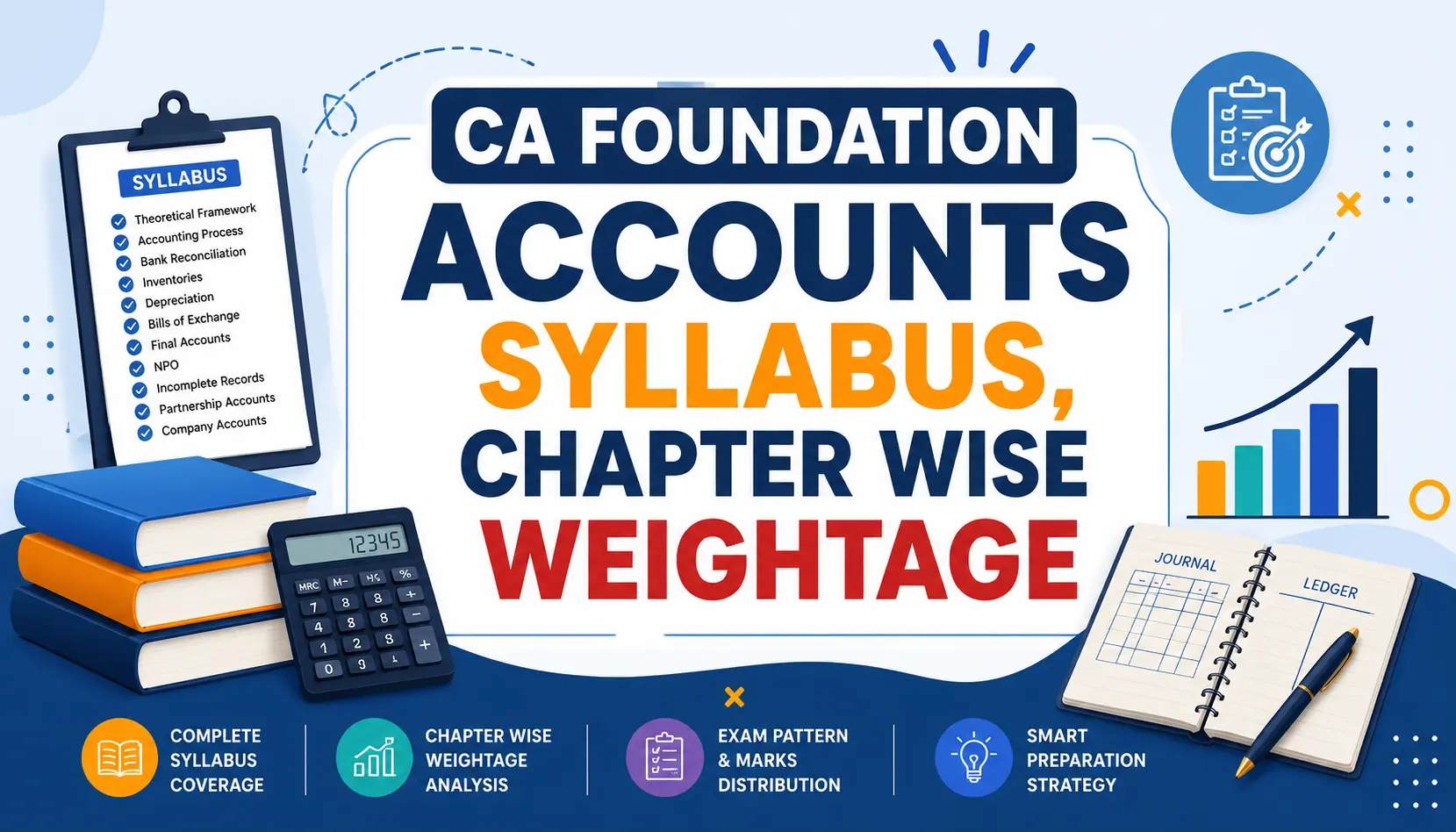
Preparing for the CA Foundation Accounts exam becomes much easier when you know which chapters carry more marks. Understanding the chapter-wise weightage helps you plan your study schedule, prioritize important topics, and revise more effectively. While every chapter is important, some topics usually contribute more marks in the examination and deserve additional practice.
In this guide, you’ll find the CA Foundation Accounts syllabus, module-wise chapter weightage, paper pattern, and preparation strategy explained in simple language to help you prepare with confidence.
CA Foundation Accounts Paper Pattern
The CA Foundation Accounts paper is designed to evaluate both your conceptual understanding and practical problem-solving skills.
Paper Highlights:
- Subject: Principles and Practice of Accounting
- Total Marks: 100
- Exam Duration: 3 Hours
- Question Type: Subjective
- Reading Time: 15 Minutes (before writing begins)
The syllabus is divided into two modules, with almost equal importance in the examination.
Module | Expected Weightage |
Module 1 | 45–50 Marks |
Module 2 | 50–55 Marks |
Since Module 2 generally carries slightly higher weightage, students should allocate sufficient time to both modules instead of focusing on only one.
CA Foundation Accounts Chapter-wise Weightage
Module 1
Chapter | Expected Weightage |
Theoretical Framework | 5–10 Marks |
Accounting Process (Journal, Ledger, Trial Balance, Cash Book, Subsidiary Books & Rectification) | 5–10 Marks |
Bank Reconciliation Statement | 5–10 Marks |
Inventories | 5–6 Marks |
Depreciation and Amortisation | 5–8 Marks |
Bills of Exchange | 5–10 Marks |
Final Accounts | 8–10 Marks |
The first module mainly covers the fundamentals of accounting. Students who are new to Accountancy should begin with the Theoretical Framework, as it builds the foundation for understanding accounting concepts, capital and revenue items, and basic accounting principles.
Topics like Journal, Ledger, Trial Balance, Cash Book, Rectification of Errors, and Bank Reconciliation Statement are comparatively easier to score if practiced regularly. These chapters also strengthen your understanding for advanced topics later in the syllabus.
Module 2
Chapter | Expected Weightage |
Not-for-Profit Organisations (NPO) | 8–10 Marks |
Accounts from Incomplete Records | 6–8 Marks |
Partnership Accounts & LLP | 15–20 Marks |
Company Accounts | 15–25 Marks |
Module 2 contains some of the highest-weightage chapters in the syllabus. Partnership Accounts and Company Accounts together can contribute a significant portion of the paper, making them essential for scoring well.
Company Accounts now includes additional concepts, increasing its overall importance. Similarly, Partnership Accounts covers multiple practical topics, so students should dedicate enough time to understanding each concept instead of relying only on shortcuts.
How Should You Prepare?
A smart preparation strategy is more effective than simply studying for long hours.
- Start with basic chapters before moving to practical topics.
- Practice numerical questions regularly to improve speed and accuracy.
- Revise high-weightage chapters multiple times.
- Don’t ignore theory-based questions, as they also contribute valuable marks.
- Solve previous practice questions and mock papers to understand the exam pattern.
Remember that weightage is only a guide. Questions can be asked from any chapter, so completing the entire syllabus is always the safest strategy.
Learn with CA Jitin Tyagi
At CA Jitin Tyagi, we believe that strong concepts lead to better exam performance. Our CA Foundation Coaching focuses on conceptual clarity, exam-oriented preparation, practical question practice, regular revision, and continuous doubt-solving support.
Students can choose online or offline classes, access structured study material, attend live sessions, practice mock tests, and receive guidance from experienced faculty throughout their preparation journey.
Conclusion
The CA Foundation Accounts Syllabus 2026 (Chapter-wise Weightage) provides a useful roadmap for planning your preparation. Module 1 builds your accounting fundamentals, while Module 2 contains several high-weightage practical chapters that require consistent practice. Instead of preparing only selected topics, aim to complete the entire syllabus and revise regularly. A well-planned strategy, combined with conceptual understanding and continuous practice, can significantly improve your chances of scoring well in the CA Foundation Accounts examination.
FAQs (Frequently Asked Questions)
The CA Foundation Accounts syllabus is divided into two modules. Module 1 generally carries 45–50 marks, while Module 2 contributes around 50–55 marks. Since both modules have significant weightage, students should prepare the complete syllabus instead of focusing only on selected chapters.
Based on the chapter-wise weightage, Company Accounts (15–25 marks) and Partnership Accounts & LLP (15–20 marks) are among the highest-weightage topics. Other important chapters include Final Accounts, Not-for-Profit Organisations (NPO), Bills of Exchange, and Bank Reconciliation Statement, making them essential for scoring well.
The CA Foundation Accounts paper is a 100-mark subjective examination with a duration of 3 hours. The paper includes a compulsory first question covering theory and objective concepts, while the remaining questions are practical and require students to attempt the prescribed number as per the exam pattern.
Start by building strong accounting fundamentals before moving to advanced practical chapters. Give extra practice to high-weightage topics, revise regularly, solve mock tests, and complete the entire syllabus. Consistent practice and conceptual clarity are the most effective strategies for success in the CA Foundation Accounts examination
No. While chapter-wise weightage helps prioritize your preparation, questions can be asked from any part of the CA Foundation Accounts syllabus. Students should cover every chapter, revise regularly, and practice different question types to maximize their overall score and improve exam confidence.